These 34 Frank Gehry Buildings Are His Best—And Ones Everyone Should Know
These 34 Frank Gehry Buildings Are His Best—And Ones Everyone Should Know
How many can you name?
From Bilbao, Spain, to Los Angeles, California, Frank Gehry buildings have a way of bringing a dose of unexpected joy to every city they grace. And in a practice where few architects become household names, Gehry stands as a rare exception. The award-winning architect spent more than a half-century disrupting the very meaning of design within architecture. From the iconic Guggenheim Museum Bilbao (which Philip Johnson called “the greatest building of our time”) to the Fondation Louis Vuitton in Paris, Gehry demonstrated time and again the force that’s produced when whimsical design is done masterfully.
Born in Canada in 1929, Gehry attended the University of Southern California and the Harvard University Graduate School of Design. He began his career in Los Angeles working for Victor Gruen Associates and Pereira and Luckman. After a brief stint in Paris working with André Remondet, the Canadian American architect returned to California and started his own firm, Frank O. Gehry & Associates, in 1962 (its successor, Gehry Partners, was established in 2002).
In the first few decades after beginning his practice, the starchitect was recognized repeatedly for his innovative and distinct approach to design. In 1989, he won the Pritzker Architecture Prize, followed shortly by the the Japan Art Association’s Praemium Imperiale Prize for Architecture in 1992, the National Medal of the Arts in 1998, the American Institute of Architects Gold Medal in 1999, and the American Academy of Arts and Letters’ Gold Medal for Architecture in 2002. In 2016, he was even honored with the Presidential Medal of Freedom by President Barack Obama. Gehry passed away in December of 2025, age 96, following a brief respiratory illness.
A man with seemingly no limits, there is no bad time to honor Gehry’s oeuvre. Below, AD surveys 34 of his most recognizable structures from around the world.
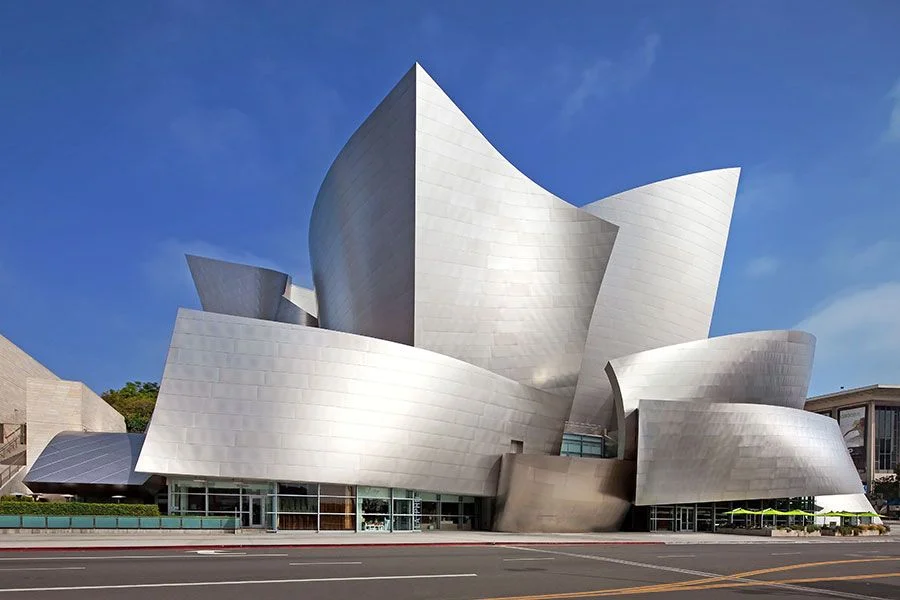 Photo: JRC/Alamy1/34
Walt Disney Concert Hall (Los Angeles, California)
Gehry was short- listed to devise a new home for the Los Angeles Philharmonic in 1988. The project, the Walt Disney Concert Hall, finally opened in 2003. Today critics and the public agree that the iconic building was worth the wait. Reflecting Gehry’s longtime passion for sailing, the structure’s exterior features expanses of stainless steel that billow above Grand Avenue, while inside, similarly shaped panels of Douglas fir line the auditorium.
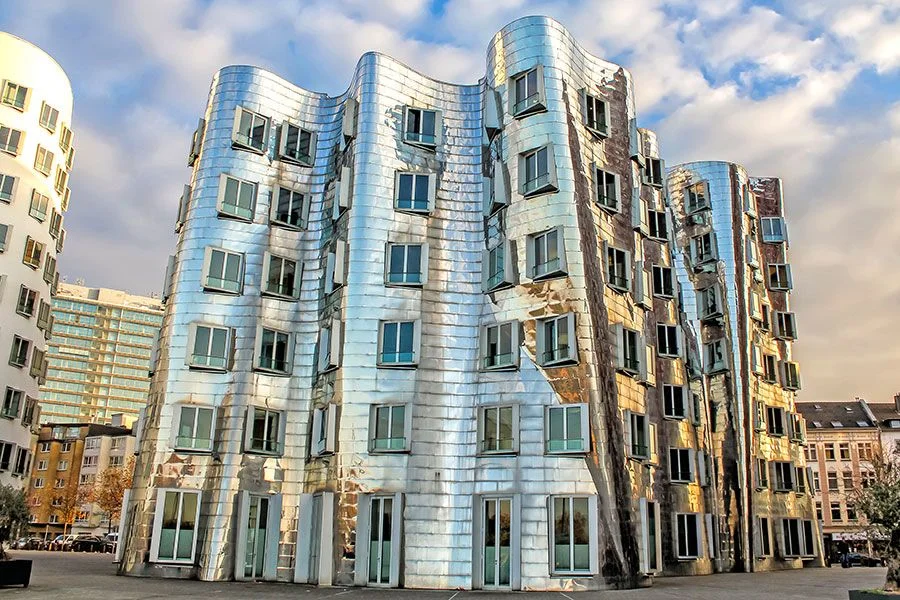 Photo: Nemanja Radovanovic/Alamy2/34
Neuer Zollhof (Dusseldorf, Germany)
Gehry’s Neuer Zollhof complex spurred the transformation in 1999 of Dusseldorf, Germany’s, waterfront into what is now called the Media Harbour. The popularity of the trio of office buildings yielded nearby commissions for other prominent architects like Fumihiko Maki and Murphy/Jahn, and earned the three towers a spot in the German edition of Monopoly.
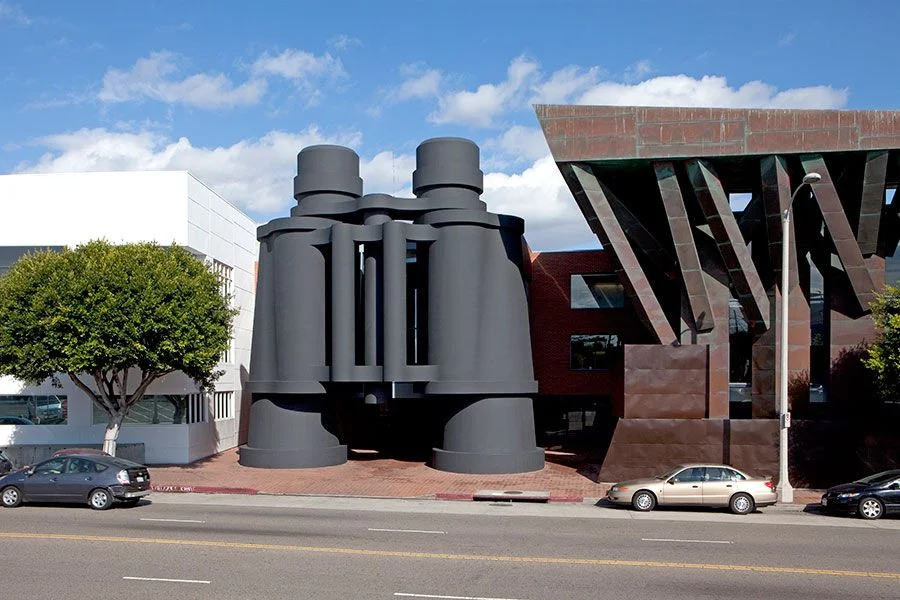 Photo: Kenneth Johansson/Corbis3/34
Chiat/Day Complex (Venice, California)
The 1991 Venice, California, complex that Gehry built for advertising agency Chiat/Day commonly goes by the nickname of Binoculars Building, thanks to the enormous pair of binoculars that mark the entrance to a parking garage—a collaboration between Gehry and artists Claes Oldenburg and Coosje van Bruggen. Office structures resembling a ship’s prow and tree trunks flank the sculpture, which now welcomes 500 Google employees to work every day.
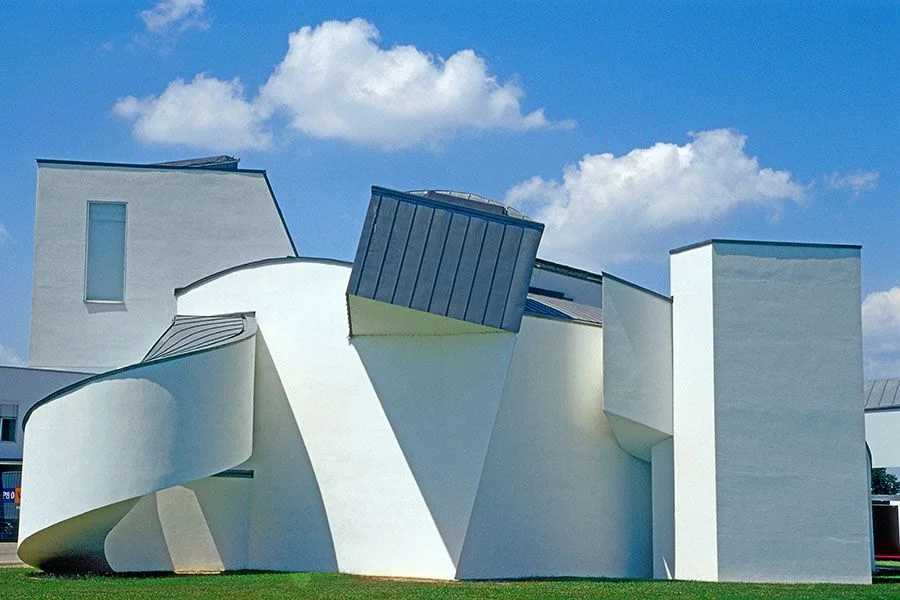 Photo: Linke/Alamy4/34
Vitra Design Museum (Weil am Rhein, Germany)
Since the early 1980s, furniture manufacturer Vitra has enlisted up-and-coming architects to create buildings for its campus in Weil am Rhein. Among them is Gehry’s Vitra Design Museum, which opened in 1989. For the 8,000-square-foot venue, Gehry piled simple geometric forms against a cubic volume, unifying them with white plaster surfaces and zinc roofing. A trip to the museum is surely worth the journey for any design lover. In addition to Gehry’s architecture, the museum houses a notable collection of furniture and product design from the iconic minds of Charles and Ray Eames, Jean Prouvé, Alvar Aalto, and George Nelson, among others.
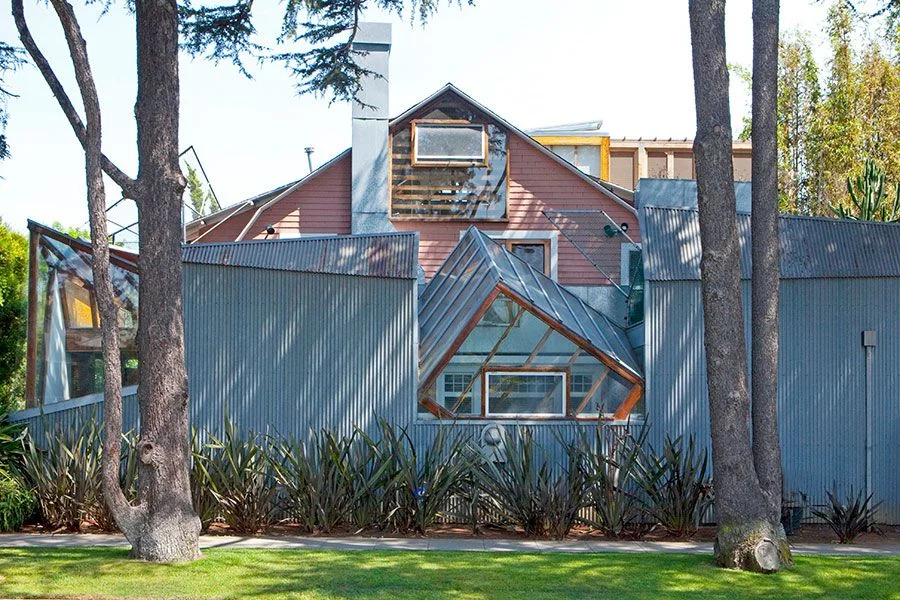 Photo: Kenneth Johansson/Corbis5/34
Gehry House (Santa Monica, California)
Gehry’s first significant brush with fame came with the 1978 construction of a Santa Monica residence he designed for himself and his family. The project wrapped an existing bungalow in angular volumes clad in a riot of everyday suburban materials like plywood and chain link. As much assailed as it was sculptural, the house earned both cheers and jeers in short order. In 2012, it won the American Institute of Architects’ prestigious Twenty-Five Year Award.
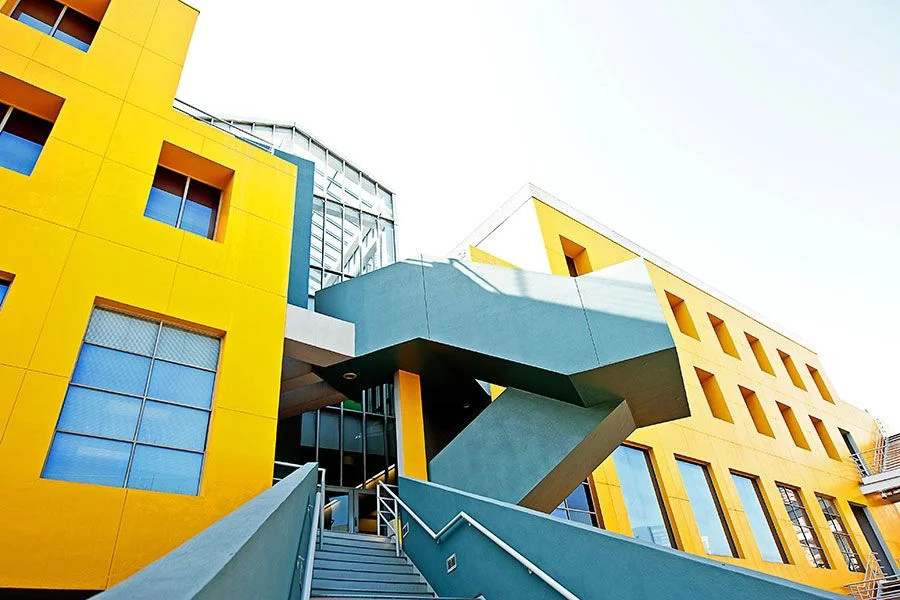 Photo: Kim Fox/Loyola Law School6/34
Loyola Law School (Los Angeles, California)
The 1978 commission to expand Loyola Law School would propel Gehry into institutional work. He reimagined Loyola’s downtown Los Angeles site as a neo-traditional campus, arranging a stylistically diverse set of buildings and surrounding them with a knoll-like landscape. During initial design work, a strategy was developed to allow the expansion of the campus in several phases, corresponding to the priorities of the school. The last phase of the design was completed in 2003.
 -/Getty Images7/34
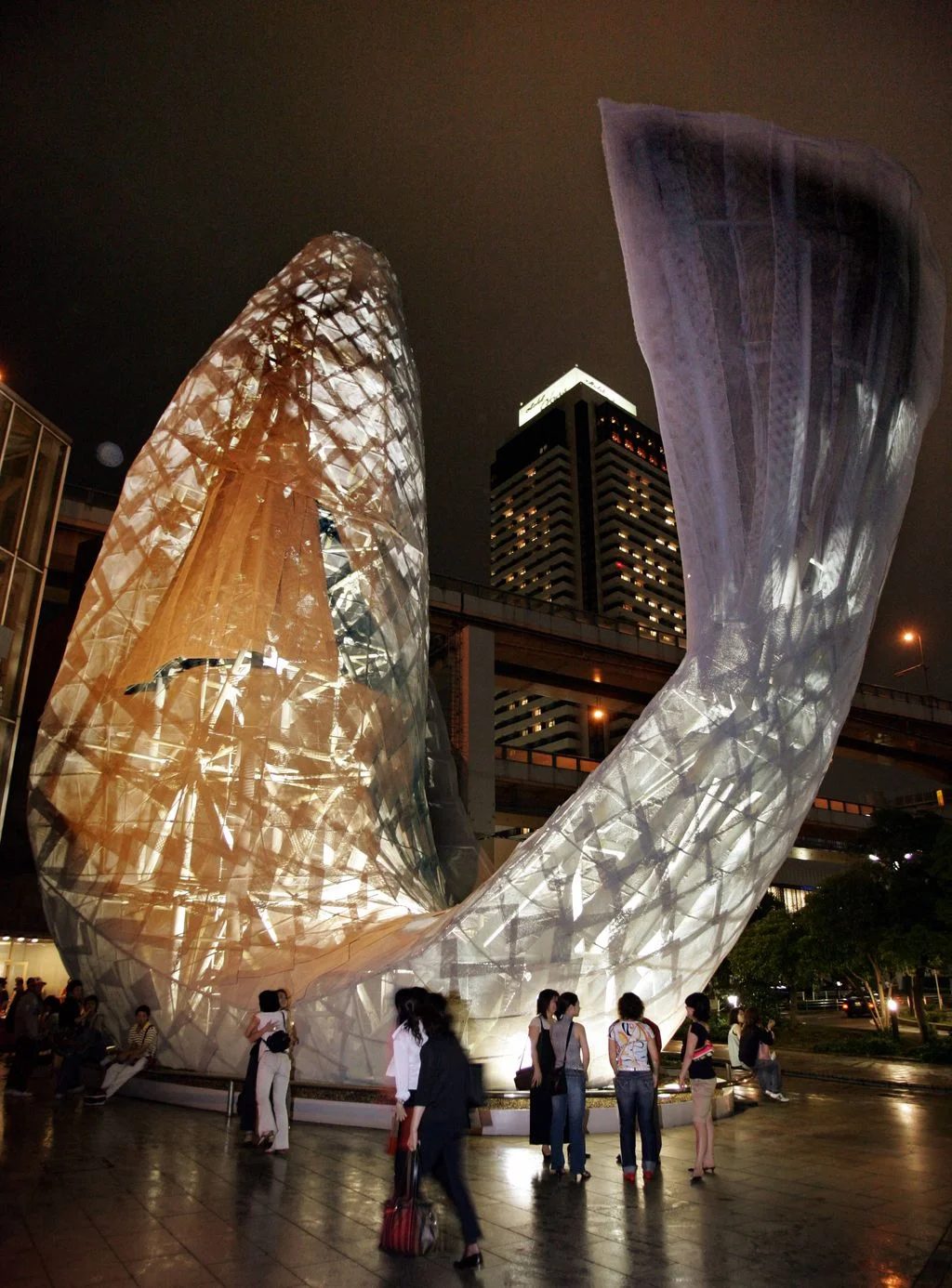
Fish Dance (Kobe, Japan)
Though not technically a building, this sculpture represents an important muse in Gehry’s work: fish. The architect has been known to include motifs of the scaled swimmers in his creations, particularly in small objects. Gehry designed this sculpture in Kobe, Japan, in 1987 under the supervision of Tadao Ando. Made of chain-link mesh, the fish sculpture sits nearby a Gehry building, which, coincidentally, is used as a seafood restaurant in the port city.
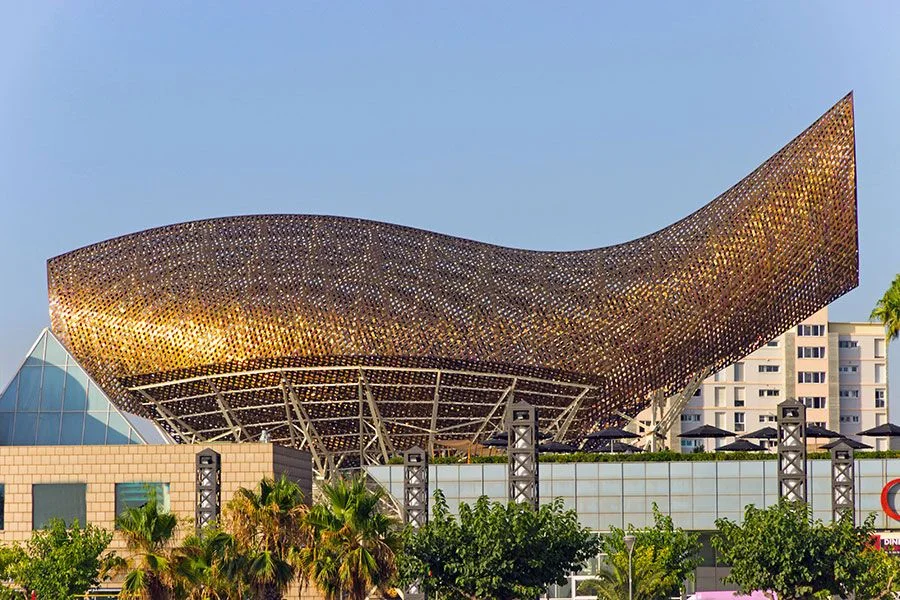 Photo: Zoonar/Vladyslav Danilin8/34
Olympic Fish Pavilion (Barcelona, Spain)
The monumental golden steel-mesh fish sculpture—another fish design—represented a technological breakthrough for the architect’s studio. Creating the sculpture for the 1992 Olympic Village in Barcelona, the firm used three-dimensional aeronautical-design software to realize the concept.
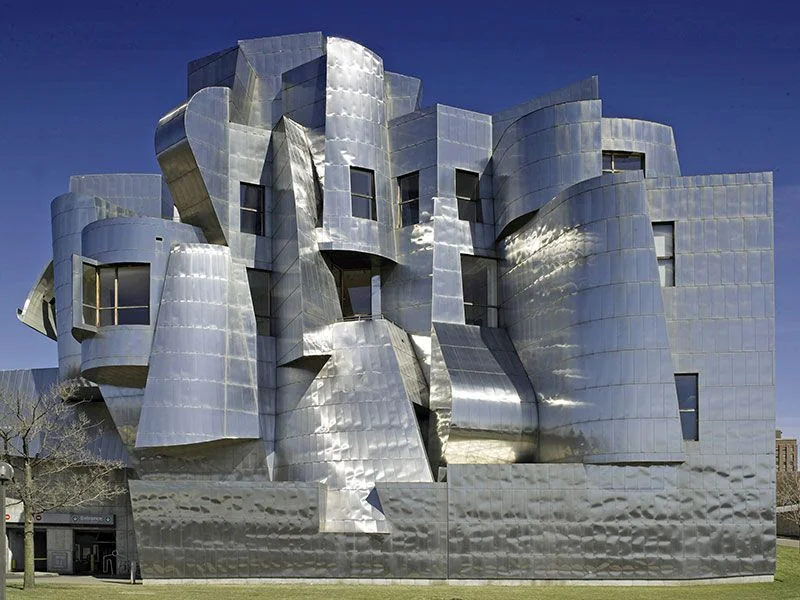 Photo: Everett Collection/Alamy9/34
Weisman Art Museum (Minneapolis, Minnesota)
Completed in 1993, the Weisman Art Museum is located on the University of Minnesota campus. Its western façade, featuring steel-clad turrets and bays, peeks over the bluffs of the Mississippi River. Construction of a Gehry-designed expansion concluded in 2011.
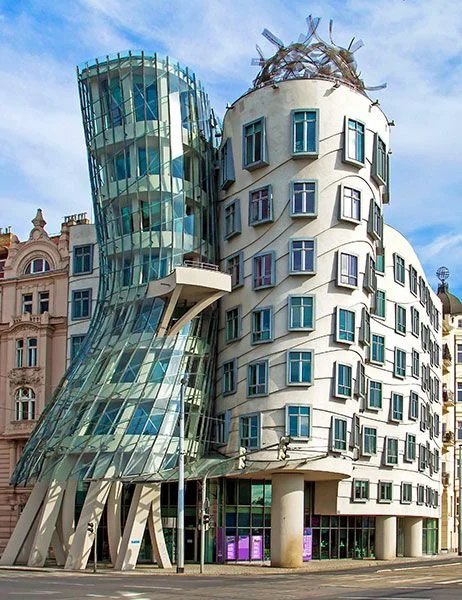 Photo: Aliaksandr Mazurkevich/Alamy10/34
Dancing House (Prague, Czech Republic)
The Prague offices of the Dutch insurance company Nationale-Nederlanden are also known as Fred and Ginger—in honor of Fred Astaire and Ginger Rogers—because of the signature pair of towers that seem to resemble a couple dancing. Now, however, the buildings are known more commonly as Dancing House, partly because Gehry didn’t want to “import American Hollywood kitsch to Prague.” The 1996 building, comprising a cinched volume of metal mesh and glass and a concrete cylinder, was a collaboration between Gehry and local architect Vlado Miluníc.
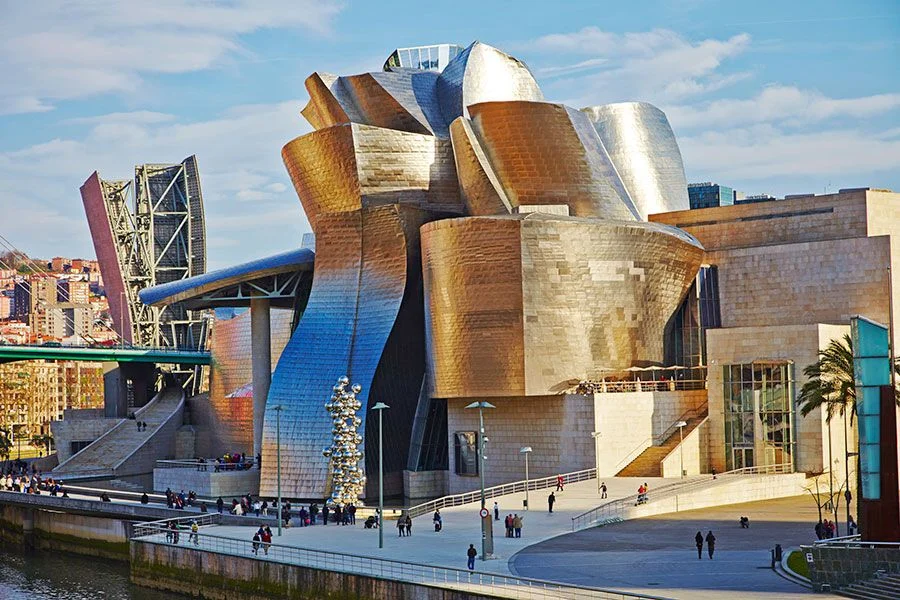 Photo: Mark Mawson/Robert Harding World Imagery/Corbis11/34
Guggenheim (Bilbao, Spain)
The Guggenheim’s satellite in Bilbao, Spain, multiplied the museum’s exhibition space in a mountain of stone, glass, and titanium that follows the contours of the River Nervión. Design and construction of the Guggenheim Museum in Bilbao went largely unnoticed in the press, so the building’s 1997 opening produced an explosion of publicity, securing Gehry’s place as a master among architects and jolting the Bilbao economy. The starchitect also designed the Guggenheim Abu Dhabi, which is expected to open in 2026.
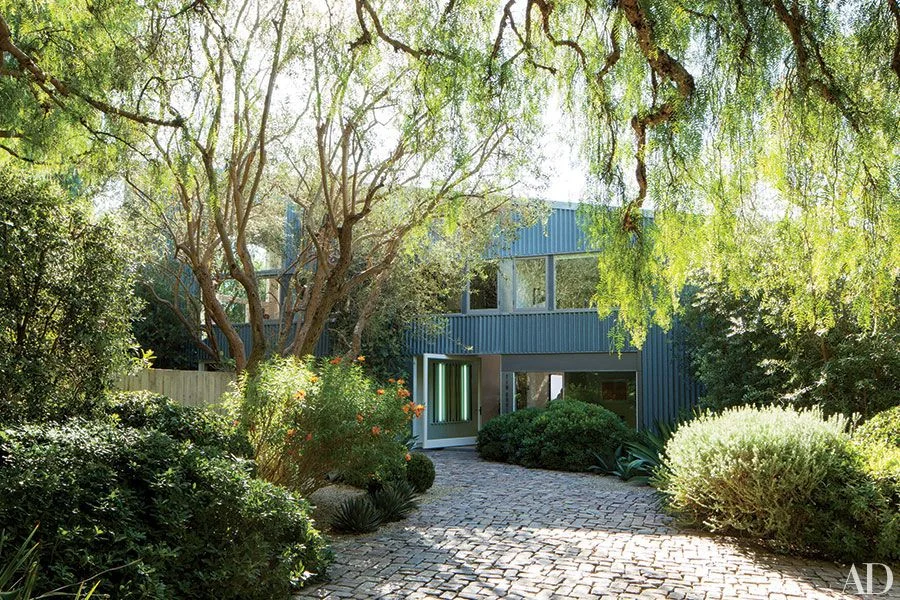 Photo: Roger Davies12/34
Davis Studio and Residence (Malibu, California)
Frank Gehry completed this Malibu residence for artist Ron Davis in 1968, six years after he launched his architecture practice in Los Angeles. While the Davis commission was not Gehry’s first project, it did presage his signature design vocabulary, thanks to a slanted roof that makes the trapezoidal house appear to torque. Today the place is home to actor Patrick Dempsey and his family. (See AD’s March 2014 cover story, “California Dreamy,” featuring the Dempseys’ house.)
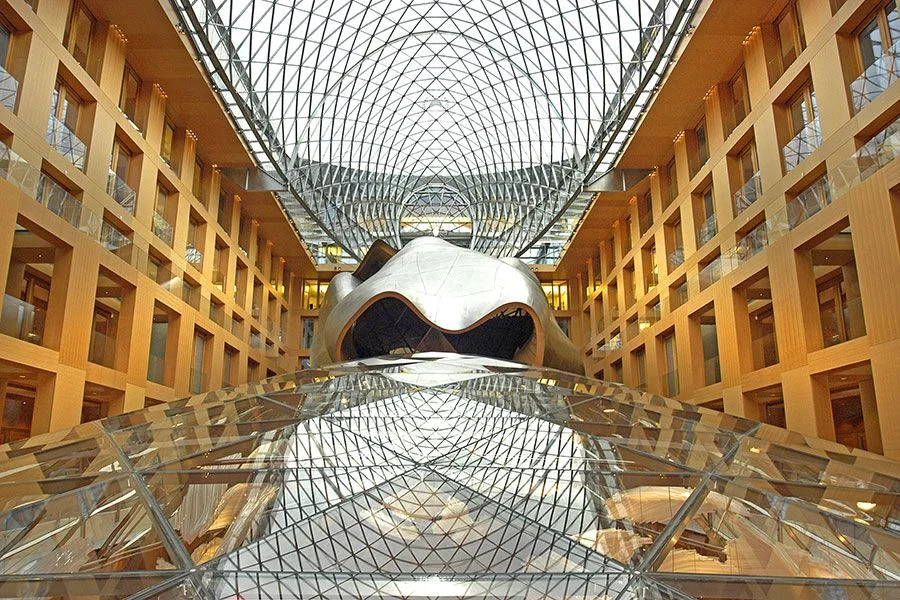 Photo: Peter Himsel/Alamy13/34
DZ Bank Building (Berlin, Germany)
In Berlin, local code prohibits any building from outshining the Brandenburg Gate. Commissioned by Hines and Frankfurt-based DZ Bank to design a branch located across from the triumphal arch, Gehry created a sober limestone façade. In addition to the office space, the building also houses 39 residential units. The most stunning component of the design, however, may be the space located between the apartments and the office. The stainless-steel room—whose shape Gehry has likened to a horse’s head—is tucked within the atrium and was designed for use as both a conference room and a performance venue.
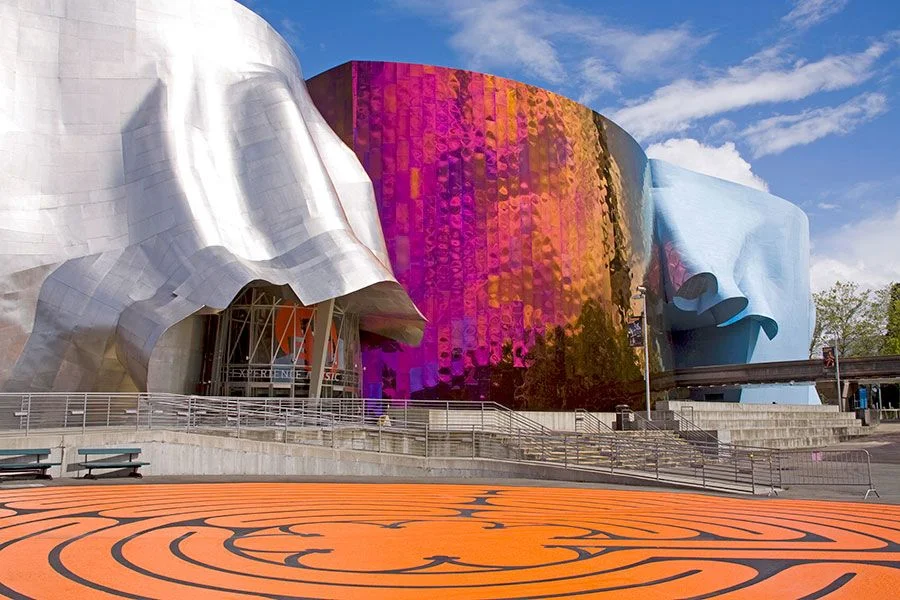 Photo: Richard Cummins/Robery Harding World Imagery/Corbis14/34
Museum of Pop Culture (Seattle, Washington)
At the base of the Space Needle, Gehry framed the Museum of Pop Culture (MoPOP) to look as if its steel and aluminum skin is flapping in the wake of Seattle’s famous monorail. Spanning 14,000 square feet, the interactive music museum is the brainchild of Microsoft cofounder Paul Allen, and upon its completion in 2000, was inaugurated as the Experience Music Project. “A fusion of textures and myriad colors, MoPOP’s exterior conveys all the energy and fluidity of music,” reads the institution’s website. The exterior is crafted from 21,000 individually cut stainless-steel and painted aluminum shingles, each finished to react to light conditions differently. Depending on where a viewer is standing, the appearance of the façade changes as a reminder of the similar evolution of both music and culture. Notably, Gehry’s first model of the museum was built from sliced-up guitars.
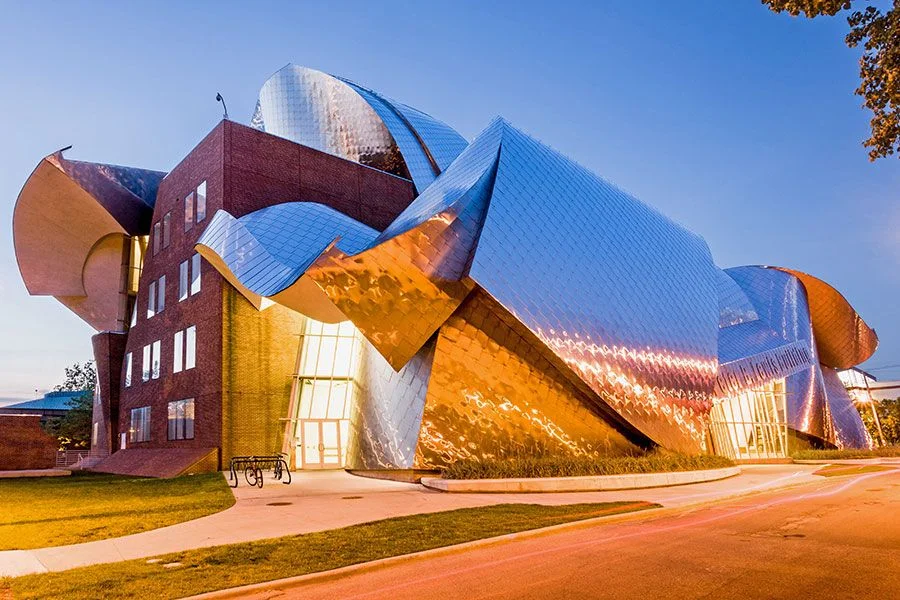 Photo: Philip Scalia/Alamy15/34
Peter B. Lewis Building (Cleveland, Ohio)
Since its construction in 2002, the Peter B. Lewis Building has housed the Weatherhead School of Management at Cleveland’s Case Western Reserve University. The building exterior is classic Gehry, with ribbons of stainless steel unfurling from a brick base. The open interior is meant to encourage cross-disciplinary socializing.
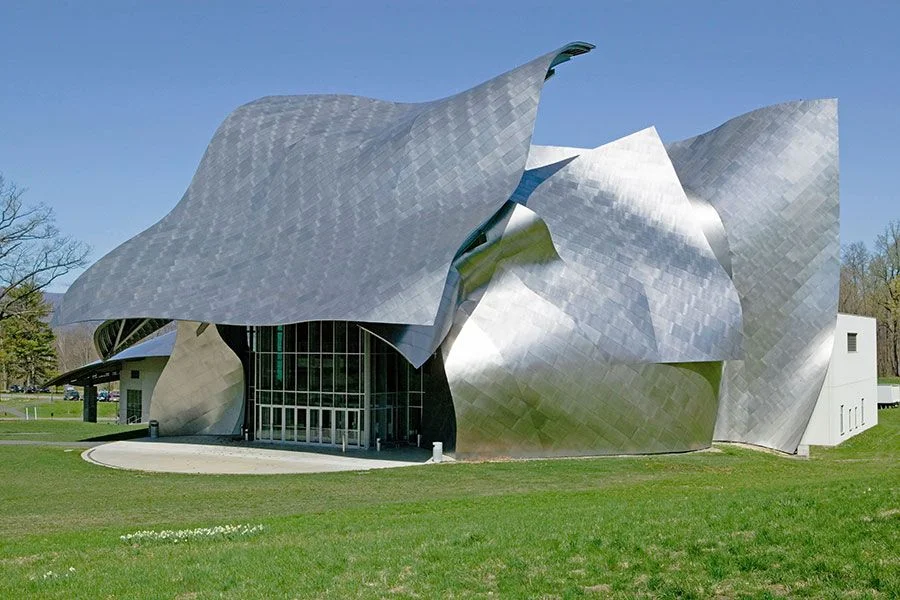 Photo: Philip Scalia/Alamy16/34
Richard B. Fisher Center (Annandale-on-Hudson, New York)
Likening the structure’s stainless-steel façade to a theatrical mask, Gehry finished the Richard B. Fisher Center for the Performing Arts at New York’s Bard College in 2003. Although he has been criticized for not advocating sustainability strongly enough, the architect incorporated geothermal energy systems and other green strategies into the building’s design, allowing the edifice to run largely free of fossil fuels.
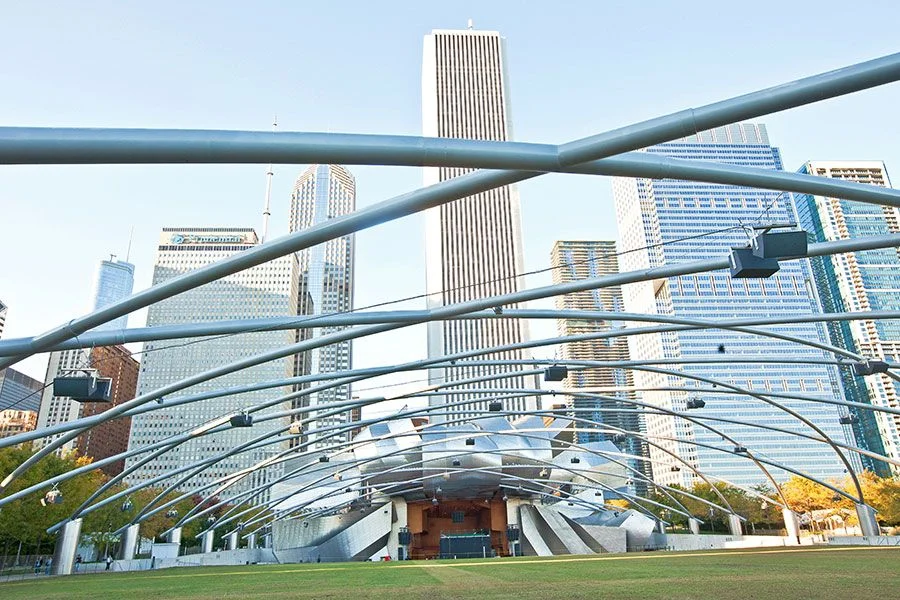 Photo: Richard Ellis/Alamy17/34
Jay Pritzker Pavilion (Chicago, Illinois)
The Jay Pritzker Pavilion was a centerpiece in the transformation of downtown Chicago rail yards into Millennium Park public square. Gehry framed the performance venue in brushed stainless-steel ribbons, which reach out toward the Great Lawn in the form of steel piping that also encloses sound distribution. The audio system has been treating audiences to concert-hall acoustics for more than a decade.
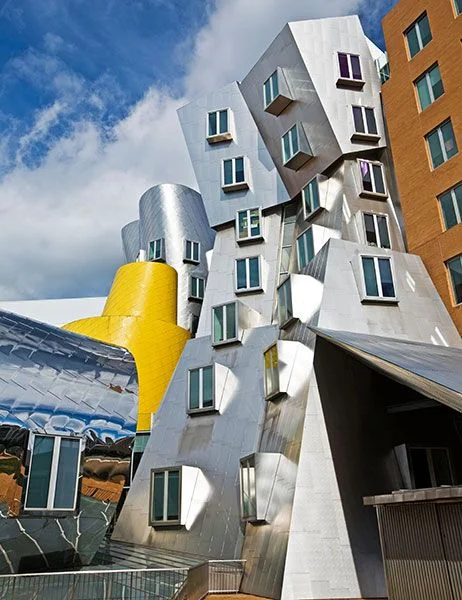 Photo: National Geographic Image Collection/Alamy18/34
Stata Center (Cambridge, Massachusetts)
The Ray and Maria Stata Center for Computer, Information, and Intelligence Sciences replaced Massachusetts Institute of Technology’s Building 20 in 2004. Its predecessor had enjoyed mythological status as a place where scientists engaged in unexpected yet highly successful collaborations. Gehry designed the Stata Center specifically to encourage occupants to interact with one another.
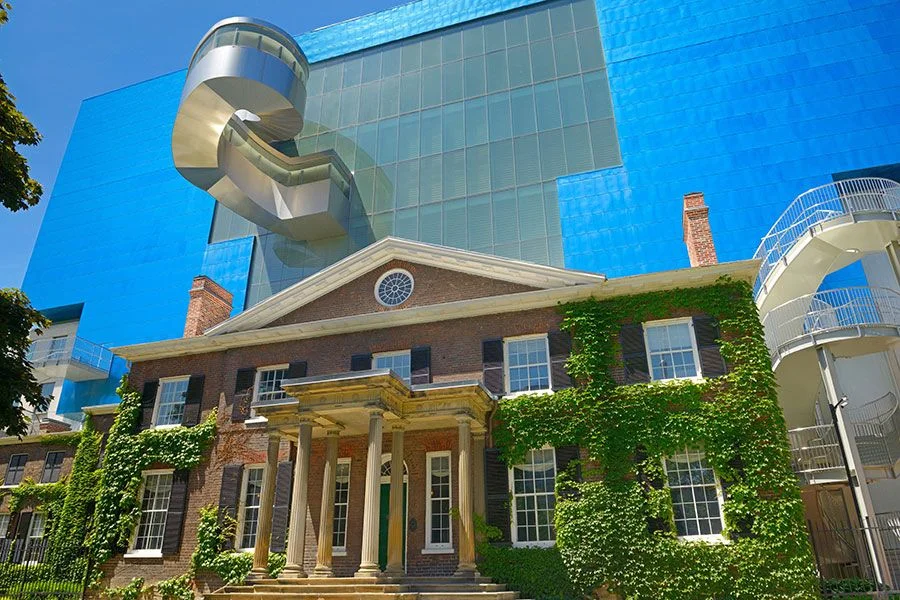 Photo: Gaertner/Alamy19/34
Art Gallery of Ontario (Toronto, Canada)
Born in Toronto in 1929, Gehry celebrated his first Canadian project there: a renovation of the Art Gallery of Ontario, just a few months shy of turning 80. The 1918 museum had already undergone expansion three times prior to the Gehry commission. In response, the architect reorganized the jumbled plan and inserted a variety of energetic and subdued volumes for additional exhibition space.
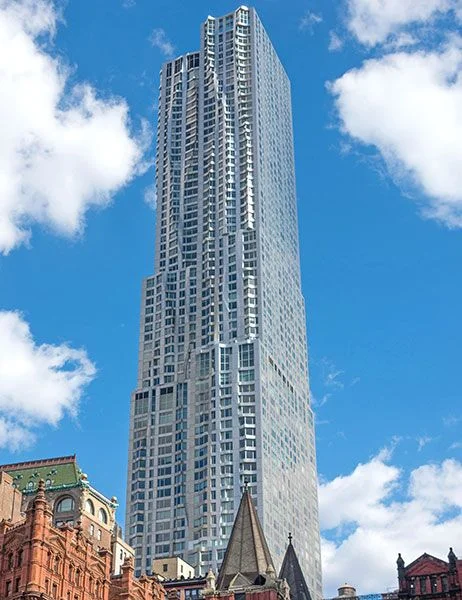 Photo: Michael Pettersson/Alamy20/34
Beekman Tower (Manhattan, New York)
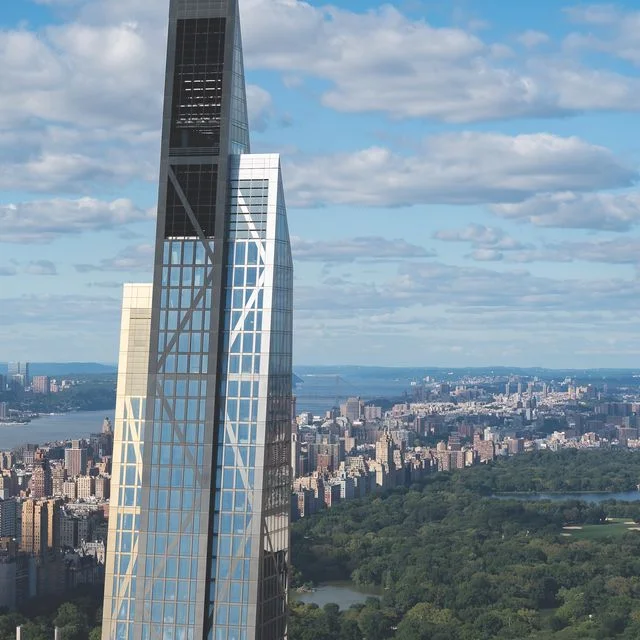
Ripples run across the exterior of Manhattan’s Beekman Tower—now dubbed 8 Spruce Street—as if a giant Super Ball had ricocheted through its interior. These pleats also function as bay windows for residents of the 76-story apartment building, which opened in 2011 and was commissioned by the development firm Forest City Ratner Co.
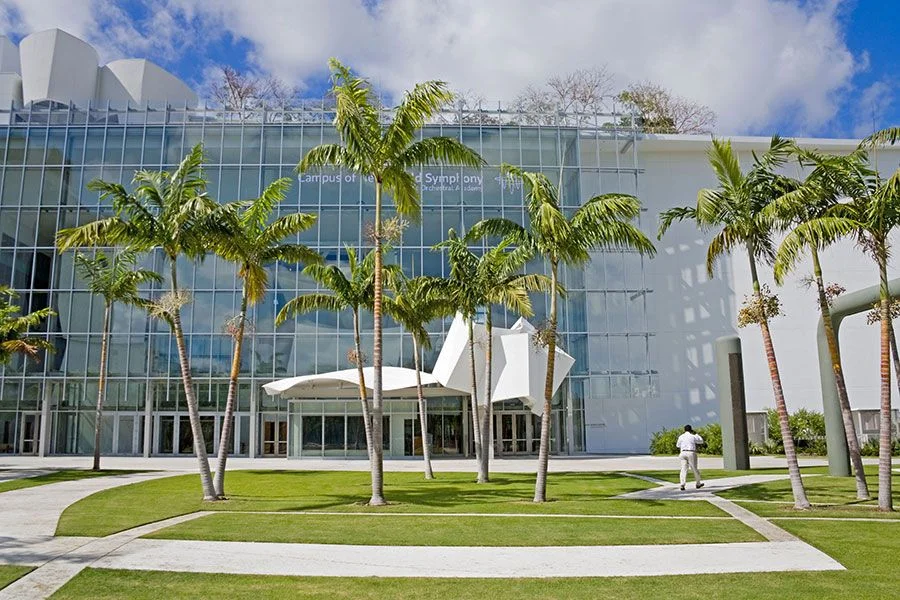 Photo: Richard Cummins/Alamy21/34
New World Center (Miami, Florida)
Gehry composed the New World Center in Miami Beach as an uncharacteristic boxlike volume. A six-story glass curtain wall allows the public outside to look into the atrium, which contains several distinctly shaped rehearsal rooms. These spaces have theatrical lighting, and performances can be seen from an adjacent park. People in the park can also watch concerts on a 7,000-square-foot outdoor projection screen.
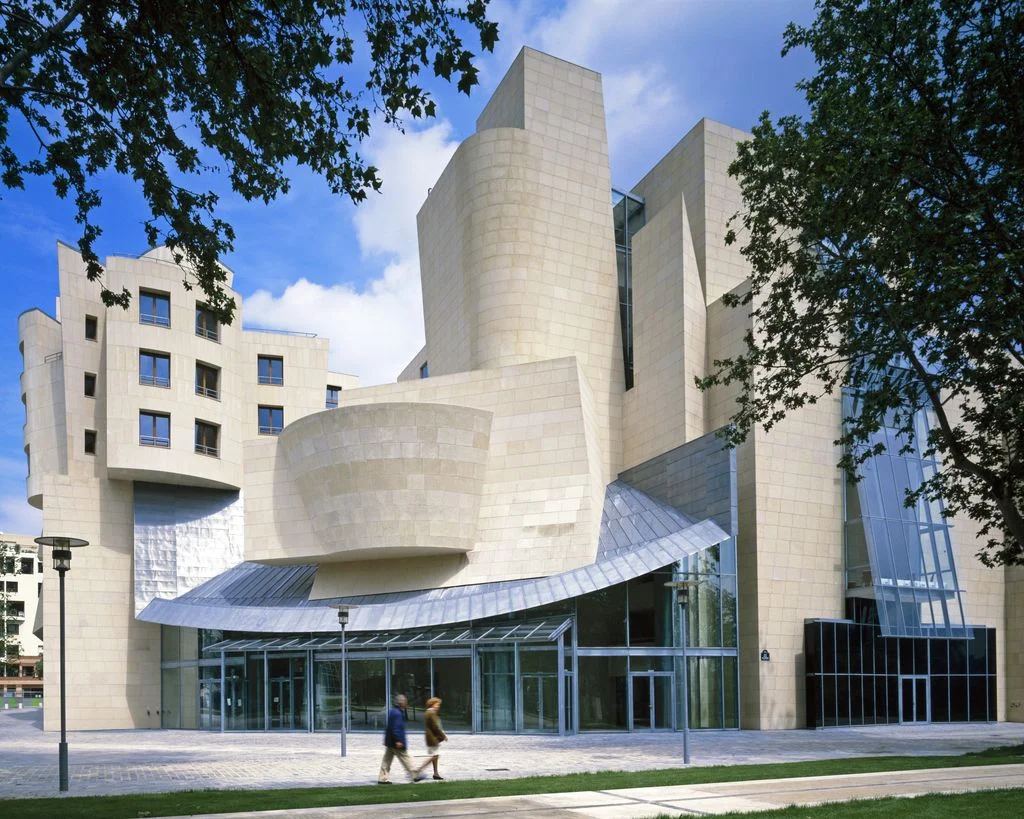 Photo: Universal Images Group/Getty Images22/34
Cinémathèque Française (Paris, France)
Gehry’s building along Paris’s rue de Bercy opened in 1994 as the headquarters of the American Center of Paris, but closed a year and a half later. In 2005, it became home to the Cinémathèque Française, a theater and archive of film history.
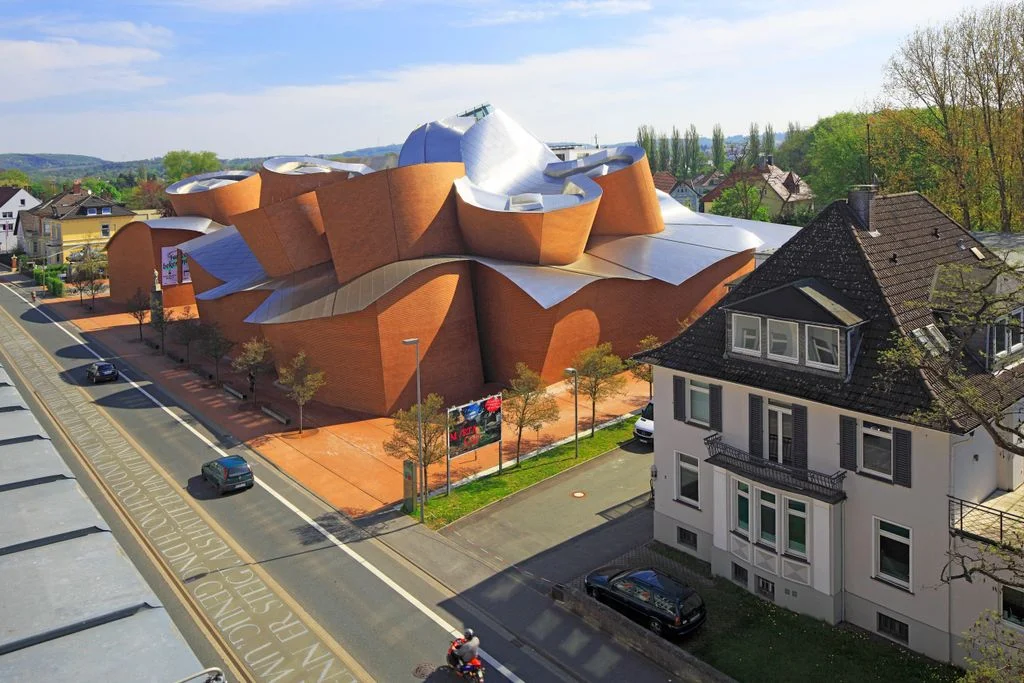 Photo: Wener Otto/Getty Images23/34
Marta Herford (Herford, Germany)
Gehry combined red brick with a gleaming stainless-steel roof for the Marta Herford contemporary art museum. Completed in 2005, the design incorporates a former textile factory that existed on the site.
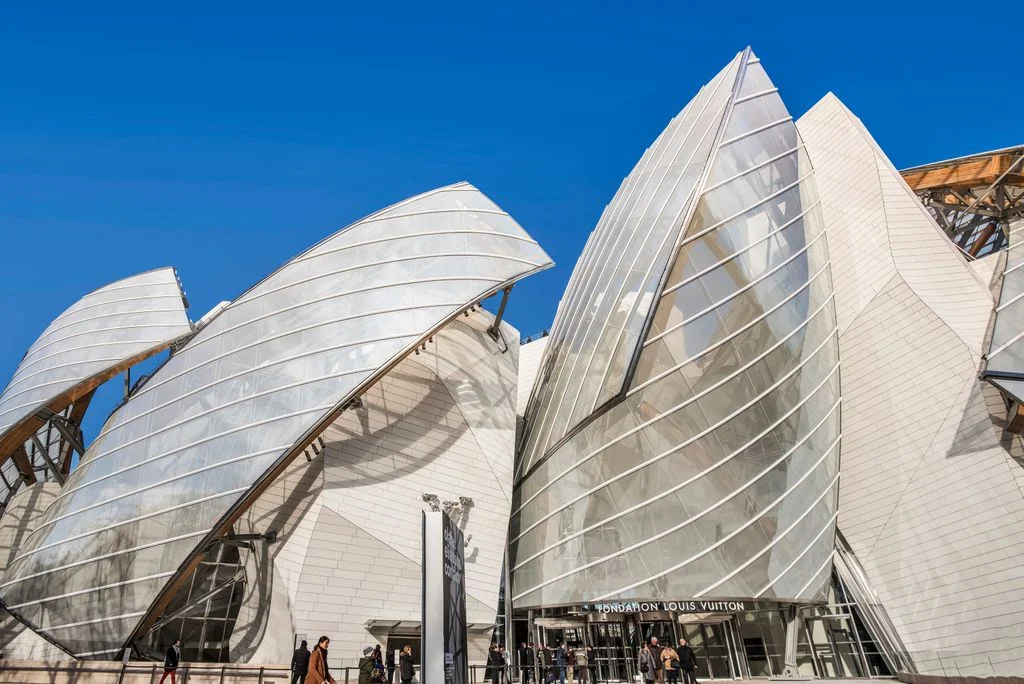 Photo: Izzet Keribar24/34
Fondation Louis Vuitton (Paris, France)
Commissioned by LVMH chief Bernard Arnault and completed in 2014, Frank Gehry’s Fondation Louis Vuitton is set in Paris’s Bois de Boulogne park. The shiplike exterior includes 12 glass “sails,” which cover the concrete-clad gallery spaces.
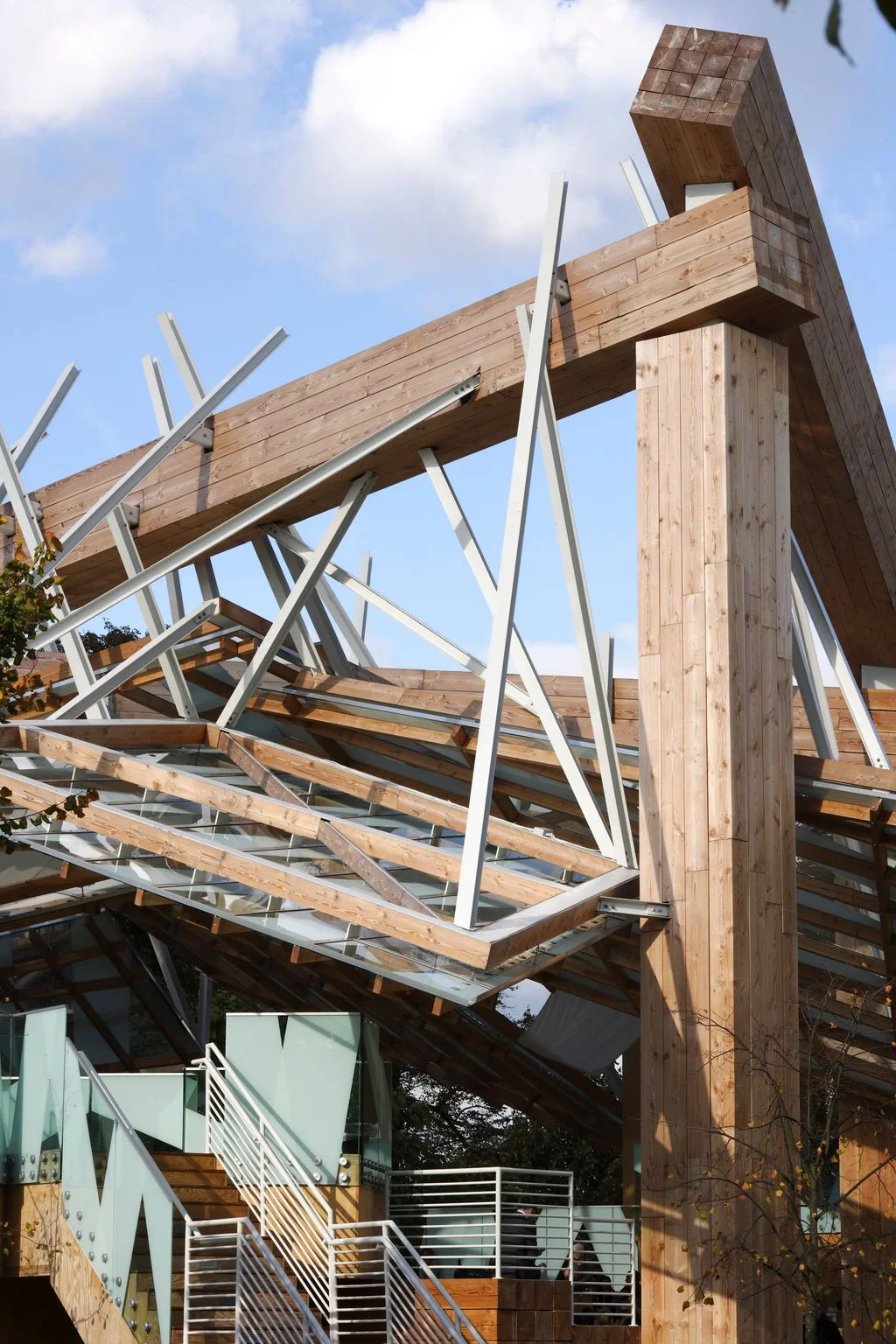 Photo: Getty Images/View Pictures25/34
Serpentine Gallery Summer Pavilion (London, England)
In 2008, Frank Gehry designed the Serpentine Gallery Pavilion in London for the popular modern and contemporary art exhibition. The structure, which consisted of four wood-clad steel columns that were being supported by a series of large timber planks and beams, was part amphitheater and part promenade. The temporary exhibit also featured sheets of transparent glass as a roof to shelter the promenade.
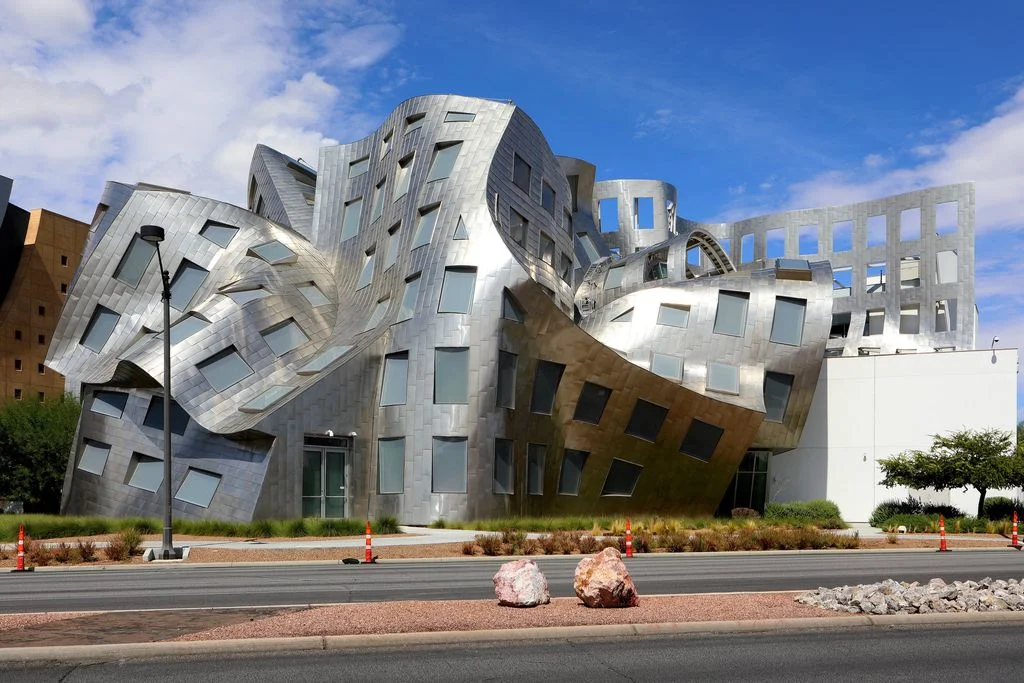 Photo: Getty Images/Raymond Boyd26/34
Lou Ruvo Center (Las Vegas, Nevada)
The Lou Ruvo Center for Brain Health was conceived by Las Vegas entrepreneur Larry Ruvo, whose father died of complications related to Alzheimer’s disease. In 2009, the Cleveland Clinic agreed to run the multifaceted medical center and research facility, which features a steel-clad event space anchored to a clinic and office building via a latticework courtyard.
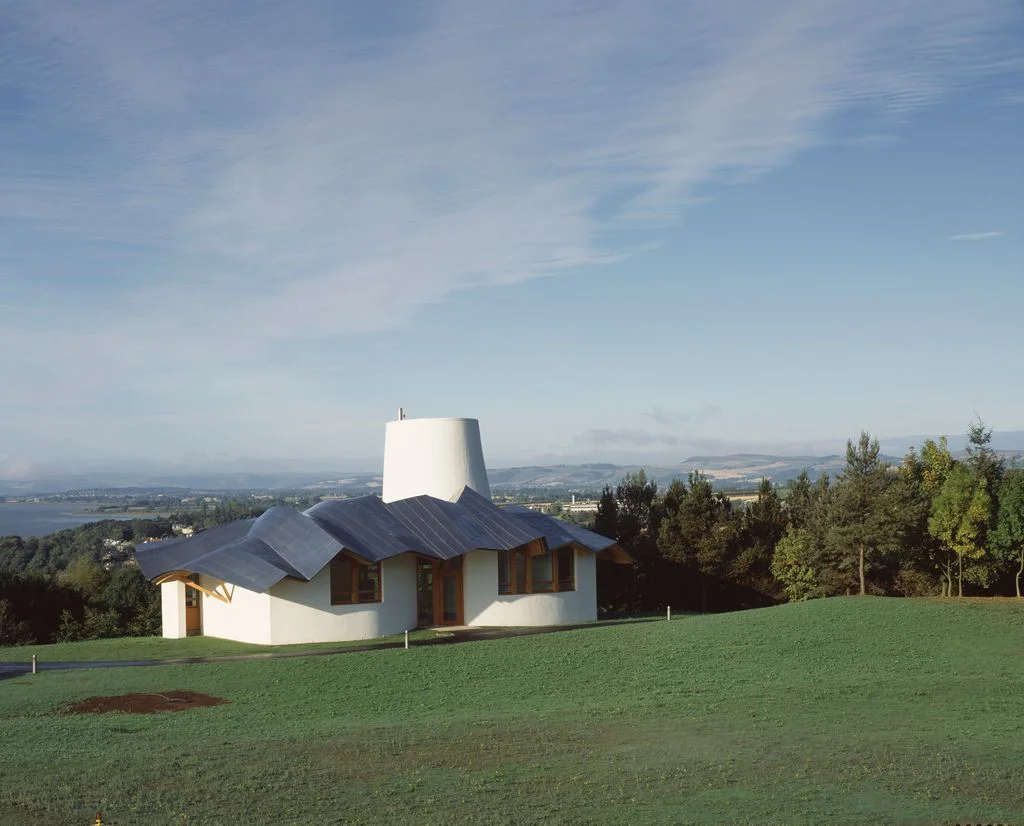 Photo: Getty Images/Raf Makda27/34
Maggie’s Centre (Dundee, Scotland)
Located on the grounds of National Health Service hospitals across Great Britain, Maggie’s Centres are support facilities for cancer patients, designed by renowned architects and operated according to principles devised by its cofounder, the landscape architect Maggie Keswick Jencks. Gehry completed the first new-build Maggie’s Centre in 2003.
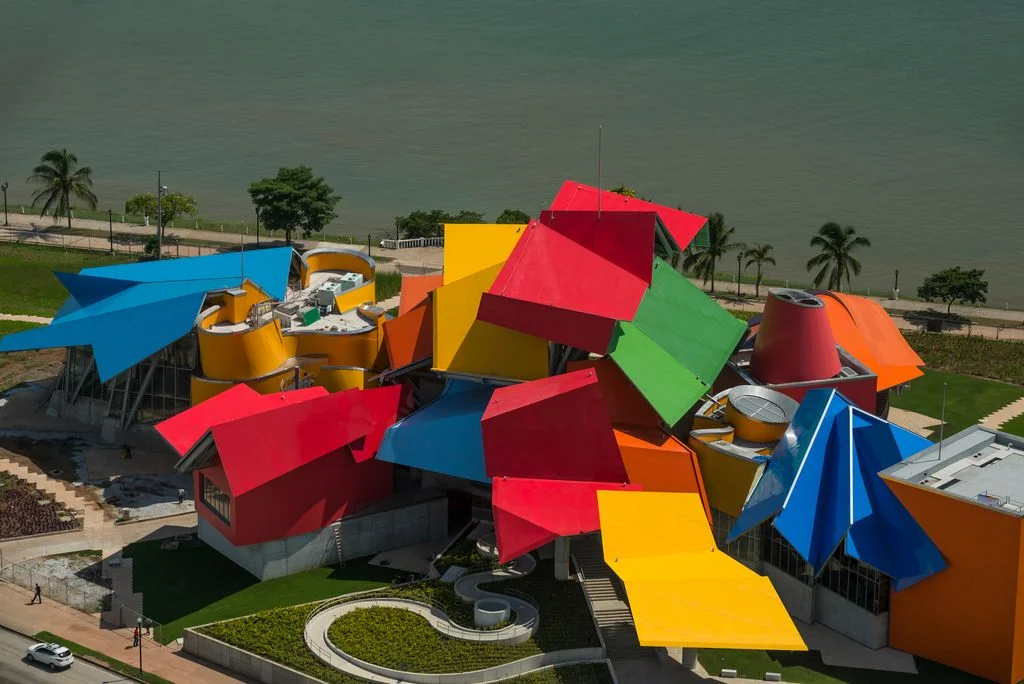 Photo: Getty Images/Alfredo Maiquez28/34
Biomuseo (Panama City, Panama)
In the late 1990s, Panamanian leaders, hoping to produce their own “Bilbao Effect,” began speaking with Gehry about designing an ecology museum. But it wasn’t until 2013 that the project was finally realized. The newly opened Biomuseo marks Panama City’s Amador Causeway with a colorfully crumpled roofline, held in place by what appears to be an oversize billboard structure. Revealing underlying armature is a traditional Gehry trope, but his uncharacteristic choice of reds, greens, and other bold hues is a direct nod to Panama’s diverse flora and fauna.
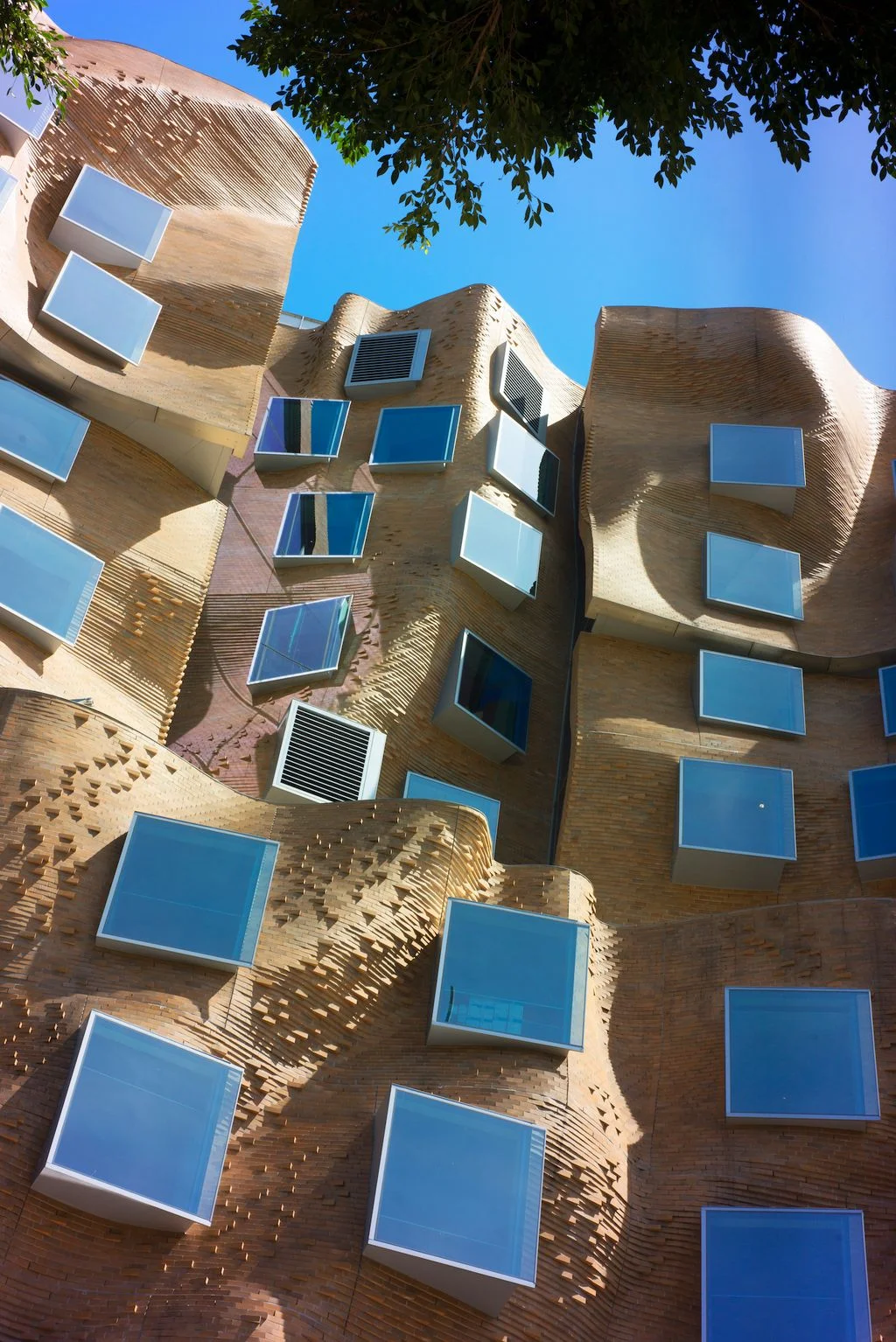 Photo: Getty Images/Peter Ptschelinzew29/34
Dr. Chau Chak Wing Building (Sydney, Australia)
The Dr. Chau Chak Wing Building at the University of Technology Sydney Business School, which opened in 2015, is Gehry’s first project in Australia. The undulating brick building includes a number of sustainability features throughout its 11 floors.
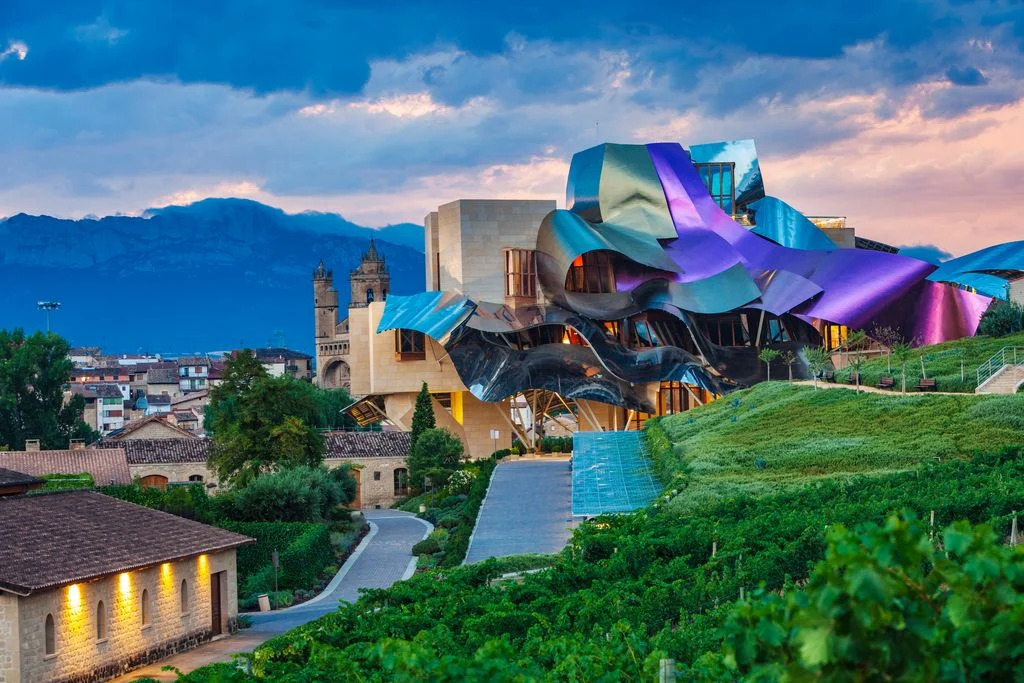 Photo: Getty Images/Gonzalo Azumendi30/34
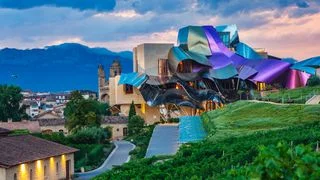
Marqués de Riscal (Elciego, Spain)
The Marqués de Riscal, built in 2006, was Gehry’s first completed hotel. The luxury lodging is located in a small town known for its vineyards and wineries. Despite sharply contrasting with the surrounding vineyards and historic estates, the hotel undeniably celebrates the town for its signature product, wine. The titanium panels that ribbon in waves reference the colors of the Rioja wine: pink for the hues of a well-aged red wine, silver for the capsule, and gold for the wire mesh that adorns the bottles. Similar to how Gehry’s Guggenheim Museum Bilbao rejuvenated that Spanish city, Marqués de Riscal has brought more tourists to this region of the country.
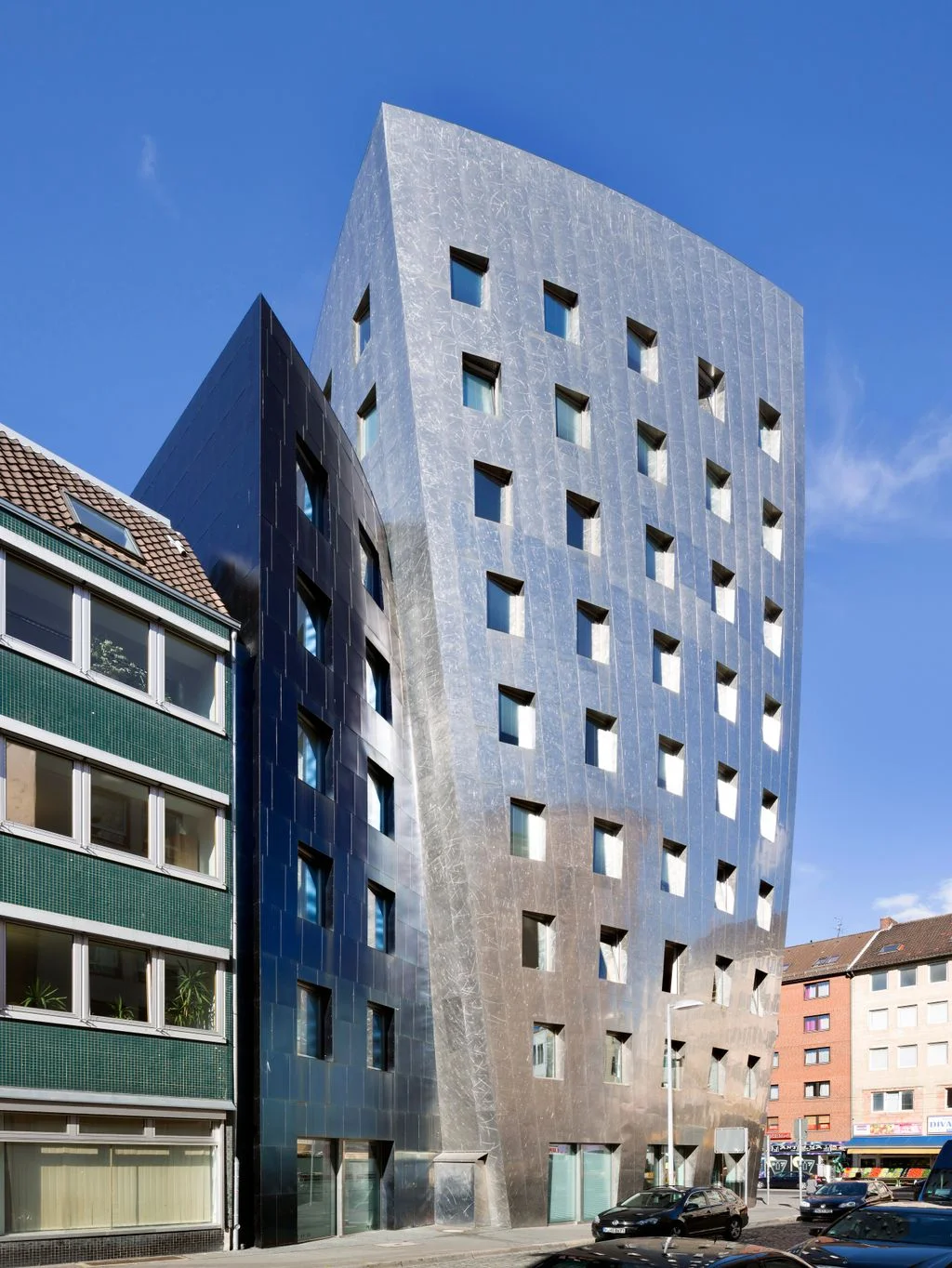 Photo: Getty Images/Thomas Robbin31/34
Gehry Tower (Hanover, Germany)
The Gehry Tower, which was completed in 2001, is located in central Germany. Built of stainless steel, the structure features a twisted façade, which allows for the most use of office space in a relatively small bit of real estate.
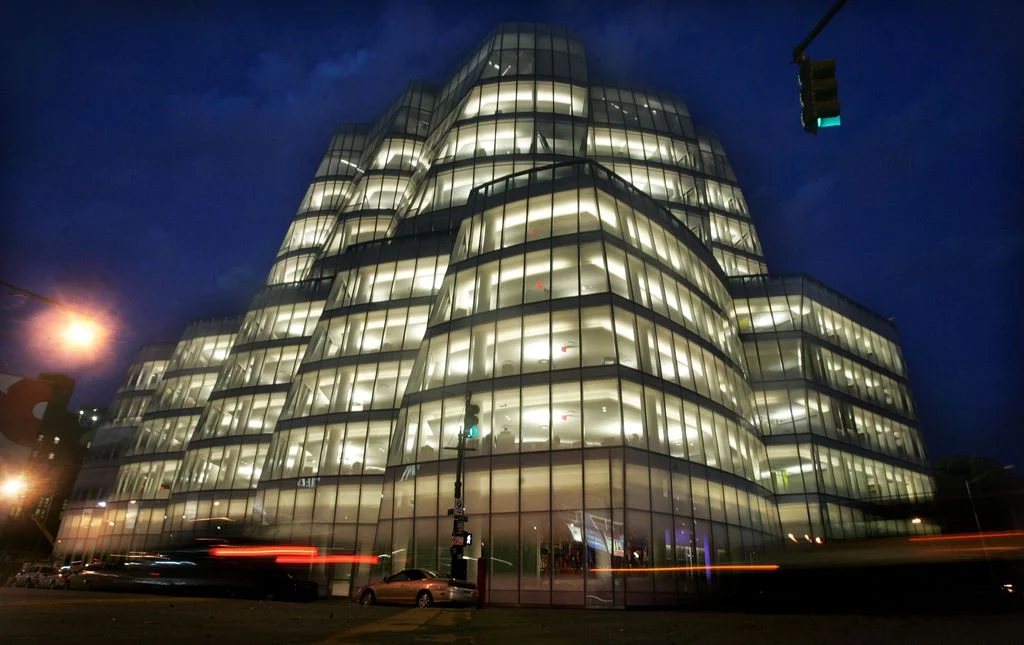 Photo: Mario Tama/Getty Images32/34
IAC Building (Manhattan, New York)
Gehry designed the IAC Corporation’s headquarters, which are located in the Chelsea neighborhood of Manhattan, in 2007. The structure is comprised of two major volumes: one larger base and a taller tower on top. The building was the architect’s first design in NYC, as well as his first major glass structure. The full-height windows make it possible to see the top and bottom of each floor, though perhaps this detail is more brilliant at night, when the building appears like a lantern against the dark sky.
 South China Morning Post/Getty Images33/34
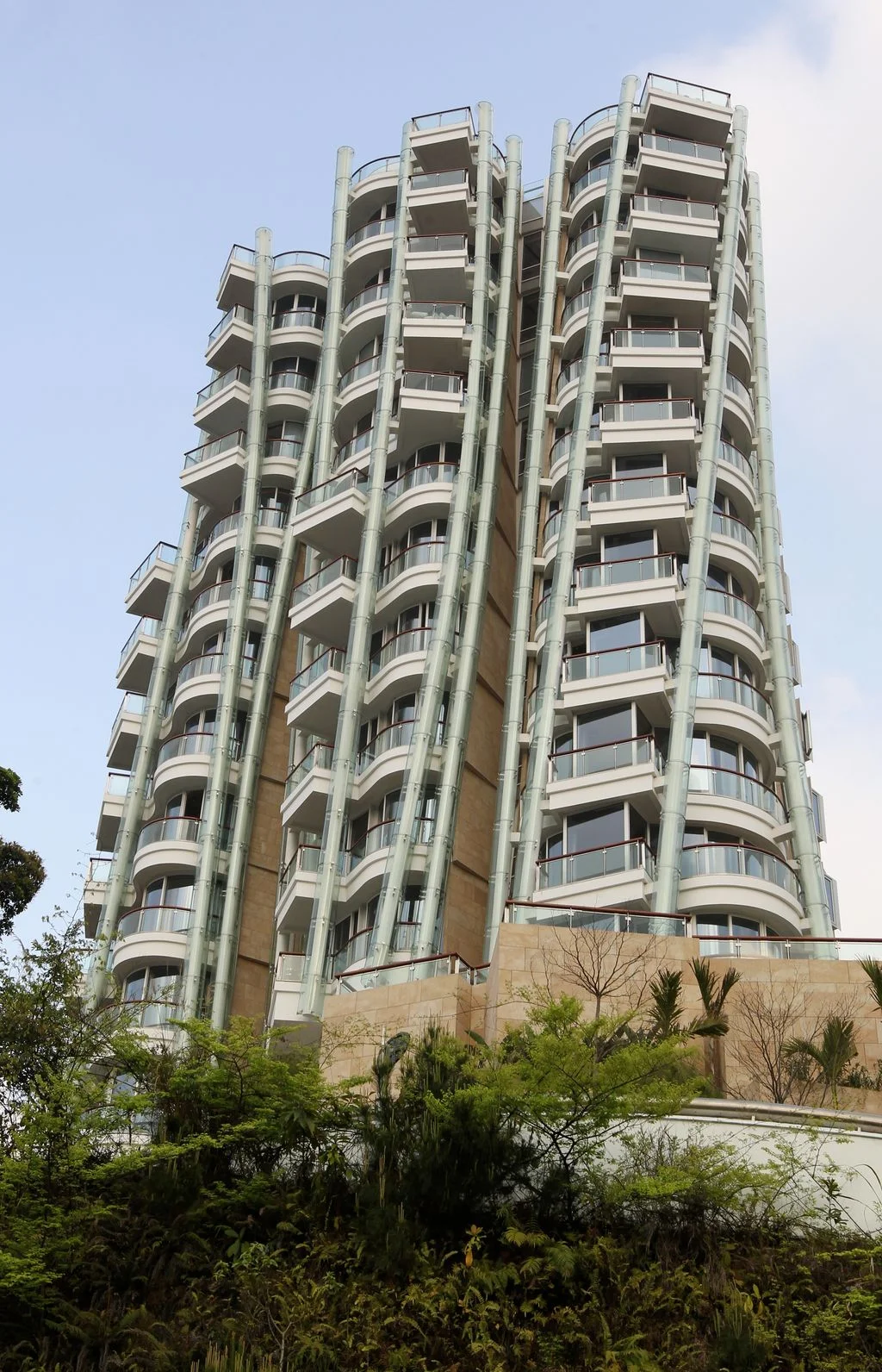
Opus Hong Kong (Hong Kong)
Opus Hong Kong, completed in 2012, was Gehry’s first residential project in Asia. The architect based the design of the 12-story building on the region’s signature flower, the bauhinia. The external columns represent bamboo shoots, while petal-shaped balconies take inspiration from the bloom. The structure holds 12 residential units, including two duplexes with pools. Additional features of the building include shared pools, underground parking, electric-car charging systems, gyms, and a rainwater recycling system for irrigation. Gehry designed the tower in collaboration with Ronald Lu and Partners.
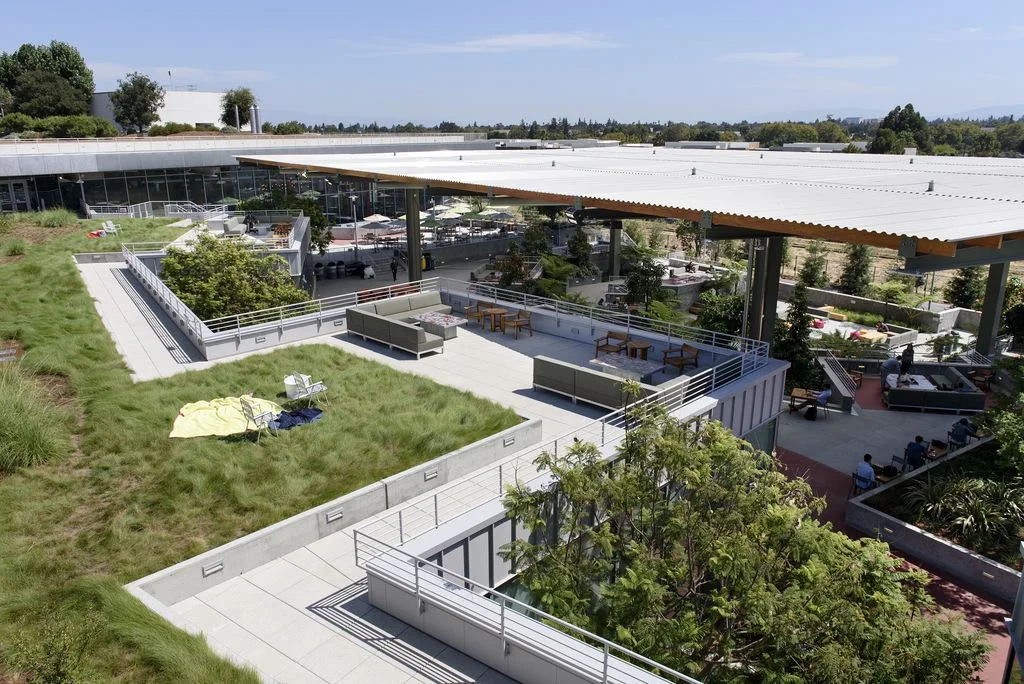 Photo: Michael Short/Bloomberg/Getty Images34/34
Facebook West Campus (Menlo Park, CA)
Completed in 2015, Gehry’s expansion of Facebook’s headquarters (now Meta) marked a rare foray into Silicon Valley corporate architecture for the starchitect. Conceived as a single vast room beneath a nine-acre landscaped roof, the low-slung building was designed to foster collaboration among thousands of employees. Gehry worked closely with founder Mark Zuckerberg to create what was, at the time, one of the largest open-plan offices in the world. The rooftop park—complete with walking trails and native plantings—softens the project’s immense scale and reflects Gehry’s long-standing interest in blurring the boundaries between architecture and landscape.
Frequently Asked Questions
What are Frank Gehry’s most famous buildings?
Frank Gehry’s most iconic buildings are not just those that transformed cities—revitalizing them, bringing in new travelers, or offering a touch of something new to storied places—but also how they transformed how the world considers contemporary architecture. At the top of that list is the Guggenheim Museum in Bilbao, Spain, a rippling series of titanium curves that helped launch the now-legendary “Bilbao Effect,” illustrating how architecture alone can revitalize an entire city’s economy and cultural profile.
In the United States, the Walt Disney Concert Hall in Los Angeles, California, is another defining body of work for the architectural titan: With sweeping stainless-steel surfaces that capture light and evoke the very movement embodied by music, it has cemented its place as both a civic symbol and beloved cultural space. Gehry’s Foundation Louis Vuitton in Paris, with its luminous glass “sails,” stands as a breathtaking counterpoint to the city’s historic fabric—a testament to his uncanny ability to insert boldly contemporary architecture into tradition-steeped settings, without overpowering their legacy.
Other seminal works include the Vitra Design museum in Germany (the introduction of his inventive formal language to Europe); the playful Dancing House in Prague; and 8 Spruce Street (or Beekman Tower) in New York City.
What is Frank Gehry best known for?
One look at his portfolio of buildings, and it’s clear that Gehry entirely reshaped the visual language for contemporary architecture. Over the course of his storied career, he transformed buildings into truly dynamic, sculptural projects: structures that appear to twist, billow, ripple.…Gehry’s work moves in a way that architecture had not seen before. His titanium-clad Guggenheim Museum in Bilbao is often credited with redefining what a museum could be, while also demonstrating the power of architecture to revive an entire city. Likewise, the gleaming curves of the Walt Disney Concert Hall cemented his reputation for turning civic institutions into works of art in their own right.
Beyond creating individual landmarks, Gehry is celebrated for pioneering the use of advanced digital modeling software in architecture, allowing his studio to realize complex geometries that once seemed impossible to build. He was never afraid to challenge what tools were considered “normal” for his projects: When designing the Olympic Fish Pavilion in Barcelona, Gehry utilized three-dimensional aeronautical-design software to bring the concept to life.
Evidently, his work ushered in a new era of expressive, technology-driven design. Recognition followed accordingly: Among many accolades, Gehry received the prestigious Pritzker Architecture Prize, often described as architecture’s highest honor. Ultimately, Gehry is best known for the ways he challenged conventional architecture, pushed it beyond its limits, and designed distinctive buildings that experimented in ways never seen before.
Why did MIT sue Frank Gehry?
In 2007, MIT filed a lawsuit related to the performance of the Ray and Maria Stata Center, the ambitious academic complex Frank Gehry designed for the university’s computer science and artificial intelligence labs. Completed in 2004, the building quickly became one of the architect’s most recognizable works, known for its lopsided tilting towers and irregular angles (if there was one word to embody the building, it would be “askew”).
But behind the scenes, problems emerged. MIT alleged the design and construction flaws led to water leaks, cracking masonry, mold growth, and drainage issues. The university claimed the defects were costly to repair and argued that both the architect and the construction team bore responsibility. Gehry, for his part, publicly defended the project, suggesting that some of the issues stemmed from construction execution rather than design intent.
The lawsuit was ultimately settled out of court in 2010. While the dispute sparked debate about the risks of highly experimental architecture, the Stata Center remains a landmark on campus, and a testament to Gehry’s willingness to push boundaries, even at institutional scale.
More Great Stories From AD
Not a subscriber? Join AD for print and digital access now.
Sign up for our daily newsletter to get the best of design in your inbox.