Cutting down a tree can be quite an arduous undertaking, and how to kill a tree stump is a bit of a mystery. But if a tree is long in the tooth (or…branch?) and threatens to fall over, cut down it must be. You may also need to remove a tree whose roots are damaging water lines or your home’s foundation, or whose location prevents a home improvement project you want to complete. Either way, tree removal does not end with the felling of the tree: In the aftermath, you’re going to have to ask yourself how to kill a tree stump. And that’s true even if you don’t plan to use the space where the tree once stood; it turns out that a tree stump left just sitting around can cause a host of new problems. We know because we spoke to multiple arborists about tree stump removal. And while there’s more than one way to remove a tree stump, the consensus is universal: You need to kill a tree stump to consider tree removal truly complete.
“Old stumps attract pests, harbor fungi, and become tripping hazards,” says Melissa Rolston, chief strategy officer at Paramount Landscaping. “Some even try to regrow. Removing them protects your soil, prevents infestation, and keeps your yard design intentional.”
Rolston added that the type of pests a moldering stump can attract aren’t an issue that will necessarily affect that old stump alone—the pest problem can spread. Insects like ants and termites that might be drawn to a tempting tree stump can multiply and spread out across the property, potentially damaging healthy plant life directly and/or by spreading fungi or pathogens to nearby trees and plants. That “dead” tree stump may well become the launching pad for very much alive—and very much harmful—invaders.
Now that we’ve established a few of the reasons why you might need to kill a tree stump, read on to learn about four methods you can use to get rid of a tree stump for good. Note that if the first approach fails to work on a truly tough tree stump, you can then move on to the second or third approach. If time isn’t a factor (like you’re not in a tree stump removal rush to build a new patio or solarium), then the fourth approach is the least invasive in terms of impact on the ecosystem of your property.
How to kill a tree stump
1. Use chemicals—with care—to kill a tree stump
Almost every expert we reached out to for tree stump removal tips recommended using a chemical herbicide to quickly and effectively vanquish unwanted tree stumps—for many, it was their top suggestion. Benjamin Hanley of Hanley Landscape Design tells AD that “targeted herbicides like glyphosate (potassium nitrate) or triclopyr can be applied directly to a fresh cut or drilled holes in the stump to kill the root system.” This can be a highly effective way to completely kill off a stump, but be warned: Those chemicals can be dangerous. It’s crucial to use proper protection—and to keep kids and pets at bay—if you’re using this tree stump removal method.
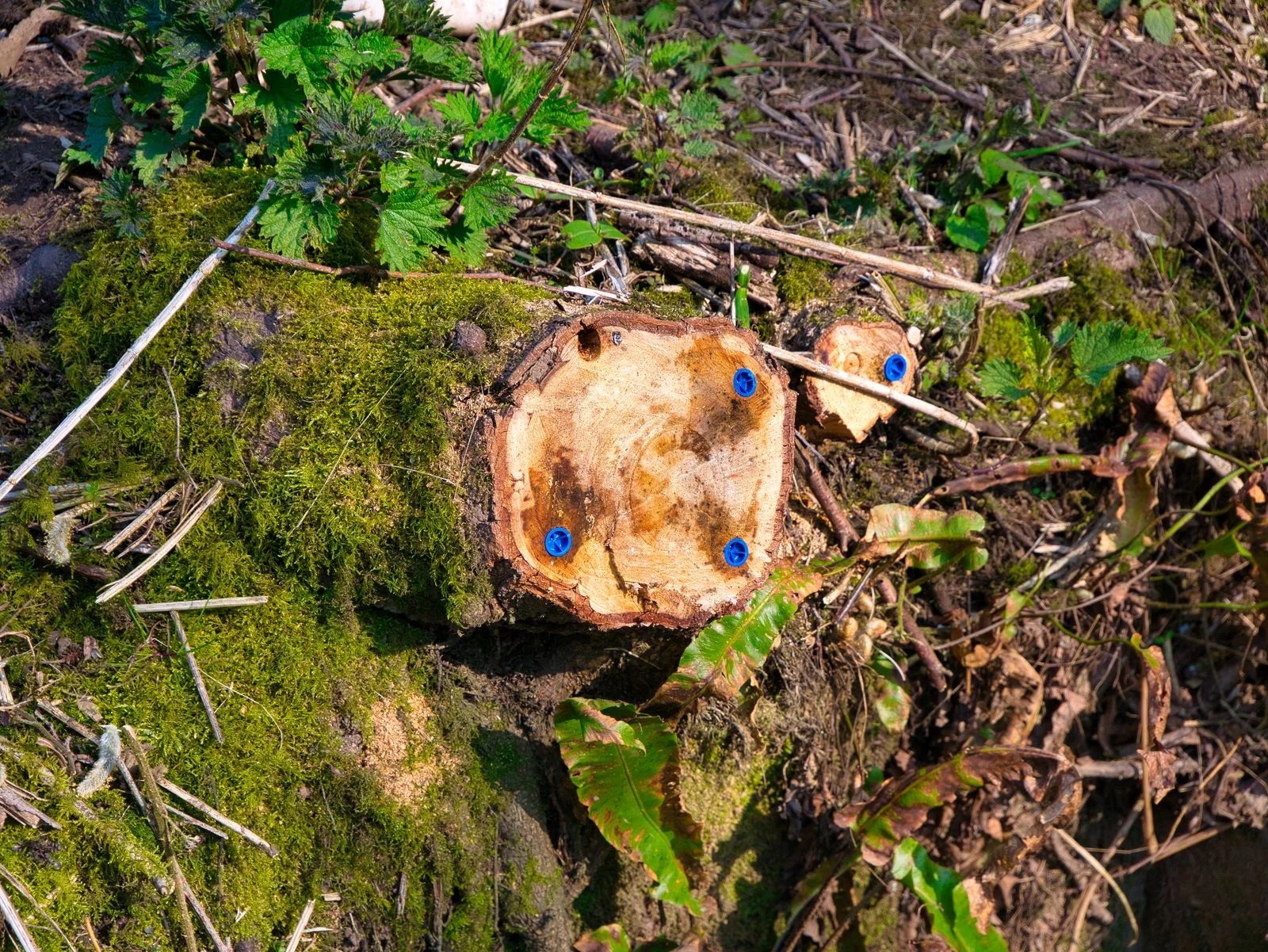
Use a chainsaw to cut the stump down as short as you safely can. Next, drill multiple holes down into the stump, with the goal of sinking them at least eight to 10 inches down.
Generously pour your herbicide of choice down into each of the holes you drilled, taking extra care not to get any of the powder or liquid on exposed skin or anywhere near your face. Then pour about a cup of water into each hole to activate the chemicals.
Cover the treated tree stump with a tarp. Secure the tarp with bungees, ropes, rocks, or a combination of items heavy enough to keep it down tightly. Within a matter of days, that stump should be effectively dead, but the process may stretch out a bit depending on the stump’s resilience. (See below FAQ on how long it takes to kill a tree stump.)
“The tarp keeps rain out and helps retain heat and moisture, speeding up decomposition,” says Gabe Boersma of Top It or Drop It Tree Service. He advises checking on the treated stump every few weeks, and “within a few months, the stump should be soft enough to break apart with an axe or shovel.”
2. Grind the tree stump out
For smaller tree stumps, you may be able to simply rip the stump and its root system out of the ground using a shovel, a pick, and some elbow grease. (Ask me about the seven or eight hours I spent battling the root structure of a rather small maple tree in the summer of 2017.) For larger stumps, “our preferred method of removal is to grind the stump,” says Hanley. “A grinder can be used to remove it below grade with minimal site disturbance. We often grind the root system as well. Homeowners can rent a compact stump grinder from a store like Home Depot or Lowe’s, or call your local tree company to grind it.”
Whether you go choose to purchase a stump grinder and DIY it, find a rental, go to the professionals, this is the priciest way to remove a tree stump—but it’s also the fastest by far.
If you have one and feel safe using it, cut the stump as low to the ground as you can using a chainsaw. Then clear away as much debris as you can, as the chainsawing process will almost certainly kick up sawdust, fallen twigs, leaves, and loose rocks. Do not let your chainsaw hit the ground! Dirt not only dulls the chain instantly, but it can also cause dangerous kickback, send rocks and other debris flying, and generally be very, very bad. In fact, if there is visible dirt on any part of the stump you’ll be cutting, including roots, rinse off thoroughly with water, then let the stump dry fully before any sawing.
Set the stump grinder in place with its cutting wheel over the stump, then fire it up and slowly lower it down. Once the cutting wheel begins to make contact with the stump, move it from side to side and forward and back as needed to slowly grind away the tree stump.
Use the stump grinder to sever and grind and large tree roots you see exposed in the grind-down process as well, and when you’re done grinding both the stump and the root system, be sure to fill the hole you have created with soil, packing it until it’s leveled off. Consider using the ground stump bits as mulch.
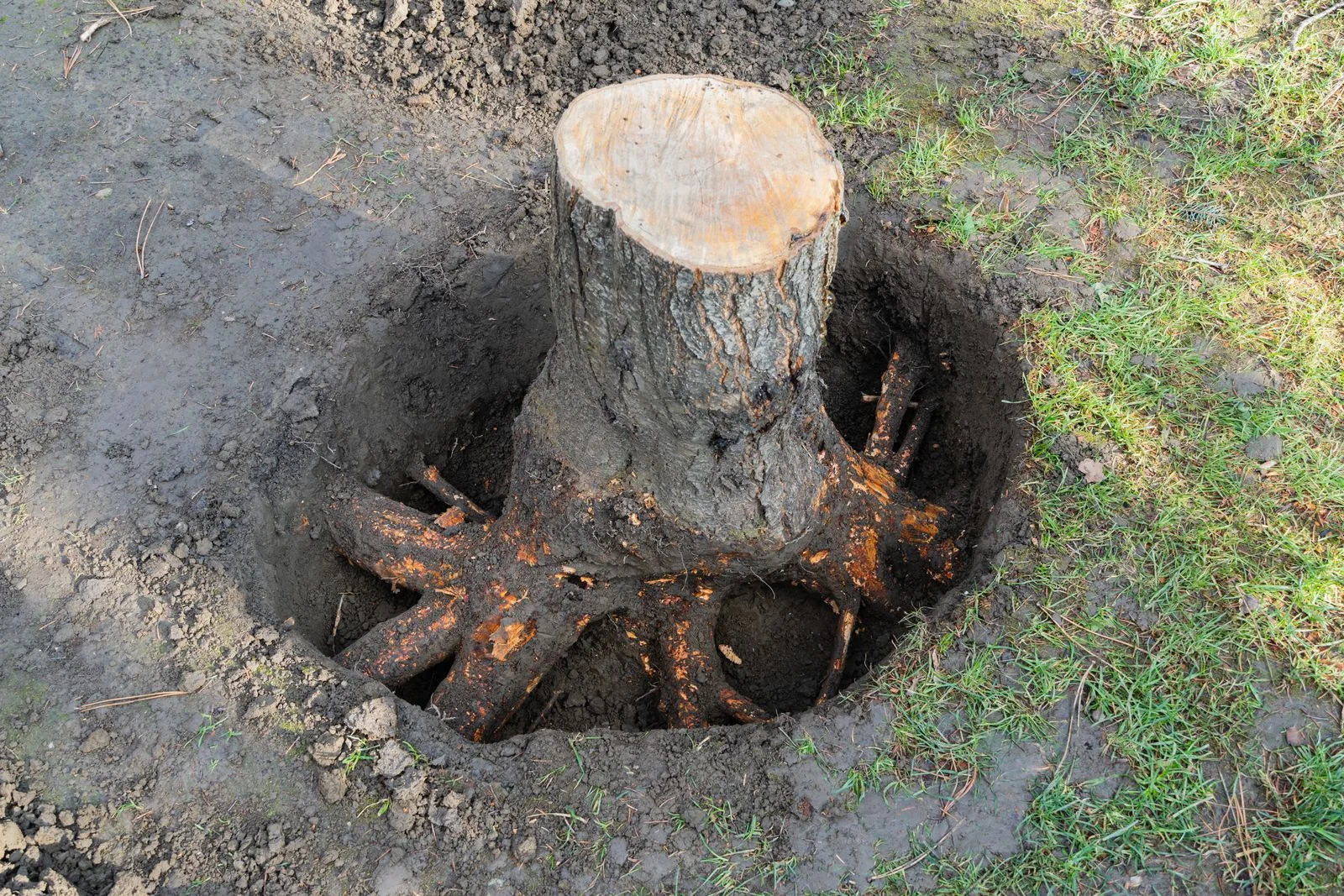
3. Kill the stump with fire
If you plan to use fire to kill a tree stump, please, put safety first, second, and third! Make sure there are no overhanging limbs that could combust, cut back and remove nearby grasses, brambles, and underbrush, and have a fire extinguisher ready to deal with any embers that float away.
Despite the many hazards one must be aware of before choosing this tree stump removal method, there are good arguments to be made for using fire to eliminate your tree stump. “The burning method deserves special attention because it does not require uprooting the stump by hand or using heavy equipment, which can be a challenge if the stump is in a hard to reach area,” says Josh Heston, co-owner of ALC Property Maintenance. “The process does not take much time but does require attention to safety.”
Ideally you would do this using a doorknob drill bit or one similar to it, making a large hole in the center of the stump and drilling down as far as you can. Then, with a smaller bit (think a half-inch), drill into the sides of the stump until you reach the main hole. (Take note: This approach will not work with extra-wide stumps, though you may be able to use it by drilling a series of holes down into the top of the stump and connecting to each hole from the side. It’s a process, to be sure, but this approach can be very effective and may be worth trying even for larger tree stumps.)
Taking great care (and wearing gloves), soak the strip or strips of cotton in gas or lighter fluid, then insert all but a few inches of the fabric into the center hole. Switch gloves for safety (be aware of gasoline residue) and then light the fabric. Make sure you are leaning well back from the hole as you apply flame, and remember to wear protective eyewear during this stage; no need for you to end up as a comical internet meme without eyebrows as a result of this process.
“In order for the stump to start burning from the inside, you need to provide an oxygen supply,” says Heston. “For this, periodically blow air through the side holes. Also, from time to time, toss in some dry branches into the central hole to maintain the flame inside.” And do not squirt in gas or lighter fluid; that’s riskier than it’s worth.
It may take several hours for a stump to burn up enough that it can be removed easily with shovels and picks. Even if you don’t plan to fully remove the stump—you just needed to kill it—the burning technique will work and is relatively low-impact.
4. The “natural” method: time, patience, and salt to kill a tree stump
You don’t need to use fire, harsh chemicals, or heavy machinery to kill a tree stump; you can opt for a much more “natural” approach—but it will take time. Essentially, for the “natural method,” per Boersma, you’ll use “the same equipment as with the chemical [approach], but swap out chemicals for epsom salt or rock salt.”

If you have one, use a chainsaw and cut the stump as low as you safely can. (Again take heed of the notes above on chainsaw stump removal safety, avoiding the blade touching dirt or rocks and so on.) Then, drill several wide holes into the stump.
Pour in enough rock or epsom salt to fill each hole you drilled, then pour over enough water to fully saturate the salt. If the salt seems to all wash down into the hole, repeat the process one or two more times, adding more salt, then more water. If a stump is particularly porous (rotting, for example) then you may need to add salt and water two or more times.
Wrap the stump in a durable tarp and secure it in place. Then it’s time to play the waiting game. “This process is slow, taking 6 to 12 months, but is nontoxic and requires very little labor,” says Michael Clark, the Founder of Yardwork. Eventually, the stump will be so broken down that the ground will reclaim it or you can remove it with a shovel.
Frequently asked questions
What household products kill tree stumps?
The most common household products you can use to kill tree stumps include epsom salts and rock salts, as noted above, but there are other things you likely have around the house that can be used as well. Like the salts (and stronger herbicidal chemicals), both of these products should be applied by pouring them down holes you drill into the stump.
You can use undiluted bleach (be careful not to breathe in the fumes) or white vinegar, and make sure to wrap the stump tightly in an airtight tarp after pouring in either DIY stump killer fluid. Do not, repeat, do not ever use bleach and vinegar at the same time for anything. Ever. Mixing these two substances together can create a dangerous and even deadly gas.
What is the fastest way to kill a tree stump and roots?
While it could be considered the most labor-intensive and costliest way to fully destroy and remove a tree stump, grinding the stump is the fastest method of removal by far. You can remove a tree stump via grinding in an hour or two, as opposed to the weeks or months it can take to kill off then dig up a stump with chemicals or other products. “Especially for large stumps that need to be removed quickly, it’s best to use a stump grinder,” says Clarke. Larger stumps may resist salts or chemicals, and may continue to resprout new shoots or harbor pests and fungi for a long while.
How long does it take to kill a tree stump?
With a stump grinder, you can kill a tree stump in an hour or two, give or take the preparation and cleanup time. On the far extreme, David Brown, owner of Reliable Tree Service, notes that it can take “six months to two years” to kill off a tree stump via “natural decomposition, [which is] the best approach for eco-conscious or low-budget approaches if you have the time to wait.”
What is the fastest way to remove a tree stump?
As is usually the case in life, throwing money at this situation is usually the fastest way to deal with it. Thus, of course the fastest way to remove a tree stump is to hire a professional tree company and have them do the stump grinding and removal for you. Based on our research and conversations, the cost of tree stump removal by a professional service will range between $400 and $600, depending on your area, the size of the stump, and factors like ease of access for machinery. It may cost closer to $300 in some places, and it may be up to $1,000 in others. But estimates tend to be free, so why not inquire?
What are the reasons to kill a tree stump?
The most basic reason to kill off a tree stump is to reclaim the space; maybe it’s in the middle of your backyard and the kids want to play there, or it would make for less hassle for you and your lawn mower. Maybe it’s in the middle of your garden and you want more planting space. The list could go on.
But there are other valid reasons that you may want to kill a tree stump—reasons that can protect your home and can protect other trees and plants nearby. “Fungal decay [from a stump] can spread to nearby plants, and the rotting wood often attracts pests,” says Hanley. Adding to that, Boersma explains that “dead stumps can attract pests like termites, carpenter ants, or fungi that can spread to nearby healthy trees or even your home’s structure.”
Can a tree grow back from a tree stump?
Yes, a tree can sometimes grow back from a stump, but it depends mainly on the species of the tree and the condition of the roots left behind. When a tree is cut down and its root system remains alive, some species are able to send up new shoots from the stump itself or from the roots, in a natural process called coppicing. Tree species such as oak, willow, maple, poplar, birch, and eucalyptus are especially good at this and can regrow surprisingly quickly, particularly if the tree was relatively young and healthy when it was cut down. On the other hand, most conifers (evergreens like pine, spruce, fir, and cedar) generally do not regrow from stumps because they lack the ability to produce new shoots from old wood, so once they are cut down, the stumps typically die. Other factors also influence whether regrowth happens, including the age of the tree (again, younger trees respond better and tend to grow back), the overall health of the root system, how high the stump was cut, and even the season in which the tree was removed.